Episode Transcript
[00:00:00] There was a morning in spring on the eastern slope outside Jerusalem when a crowd tore branches from the trees and threw their cloaks across the road.
[00:00:11] A man was riding toward the city gate. He was not riding a warhorse the way conquerors came.
[00:00:18] He was riding a young donkey, an unbroken colt. And the people who watched him pass were shouting as if a king had finally arrived.
[00:00:29] Most of them could not have told you why that animal mattered. They did not know they were standing inside the closing line of a prophecy. The words had been written down more than 500 years earlier by a man almost no one in that crowd could have named. In a city that at the time had been little more than broken stone and ash. He had written, rejoice greatly, daughter Zion.
[00:00:55] Shout, daughter Jerusalem. See your king comes to you righteous and victorious, lowly and riding on a donkey, on a colt, the foal of a donkey. That sentence sits in the Book of Zechariah, chapter 9, verse 9. The man on the donkey was fulfilling it to the letter.
[00:01:16] And to understand how a line written in the ruins of one century could land with such precision in another, we have to go back to where Zechariah actually stood when he first spoke.
[00:01:30] Because he did not begin in triumph, he began in rubble. Picture Jerusalem near the end of the sixth century before Christ. For 70 years, the city had been a ghost.
[00:01:43] In 586 BC, the armies of Babylon had broken its walls, burned the temple that Solomon had built and marched the leading families east into exile. Beside the r rivers of Babylon, what remained behind was a depopulated hill country, a scatter of villages, a capital reduced to charred foundations. The great house of God, the centre of the nation's entire identity, was gone. The gold was carried off the altar cold, the courts empty.
[00:02:18] An entire generation grew up in a foreign empire, singing about a homeland they had never seen, asking the question recorded in the Psalms, how do you sing the Lord's song in a strange land?
[00:02:33] Then the political map of the world changed. Babylon, which had seemed unbreakable, fell in a single night to the rising power of Persia. And the Persian king who took the city had a different policy toward conquered peoples than the Babylonians had.
[00:02:51] Where Babylon had deported populations to break them, Persia preferred to send them home, rebuild their shrines and win their loyalty.
[00:03:01] We are not depending only on the Bible for this. There is an object in the British Museum, a barrel shaped clay cylinder covered in cuneiform that historians call the Cyrus cylinder. On it, Cyrus presents himself as a restorer of temples and a returner of exiled peoples. To their own cities.
[00:03:24] The biblical record describes exactly such a decree falling on the Jewish exiles. The opening of the Book of Ezra in chapter one, verses one through three puts it this in the first year of Cyrus, king of Persia, in order to fulfil the word of the Lord spoken by Jeremiah, the Lord moved the heart of Cyrus, king of Persia, to make a proclamation throughout his realm and also to put it in writing. This is what Cyrus, King of Persia, the Lord, the God of heaven, has given me all the kingdoms of the earth, and he has appointed me to build a temple for him at Jerusalem in Judah. Any of his people among you may go up. In 538 B.C. the door home swung open.
[00:04:17] But coming home and rebuilding home are two different things.
[00:04:21] The first wave of returnees crossed hundreds of miles of desert road back to a province the Persians called Yehud, a small, poor, lightly populated district in the southern hill country.
[00:04:35] Archaeology of this period paints a sober picture. This was not a thriving nation reclaiming its glory.
[00:04:43] It was a thin population settling into a damaged land, surrounded by neighbours who had moved into the vacuum during the exile and were not eager to see Jerusalem strong again. The returnees had a decree, a memory and very little else. They did what their faith demanded. First, they cleared a space, set up an altar, and laid the foundation of a new temple on the site of the old one.
[00:05:12] And the Bible preserves one of the most human scenes in all of scripture from that day when the foundation was laid. The people reacted in two completely different ways at the same time.
[00:05:27] The Book of ezra in chapter three, verses 12 and 13 records it. But many of the older priests and Levites and family heads who had seen the former temple wept aloud when they saw the foundation of this temple being laid, while many others shouted for joy. No one could distinguish the sound of the shouts of joy from the sound of weeping, because the people made so much noise and the sound was heard far away.
[00:05:57] The old men wept because they remembered Solomon's Temple, the gold and the grandeur, and they could see that this replacement would be smaller, plainer, poorer.
[00:06:10] The young shouted, because to them, any temple at all was a miracle. Joy and grief in one unbroken roar carried out across the hills. And then the work stopped. This is the part that matters. For understanding the prophet, the momentum died.
[00:06:28] Local opposition, official complaints sent up the Persian chain of command. Drought, discouragement and the daily grind of survival all pressed in.
[00:06:40] People turned from building God's house to paneling their own. The foundation sat exposed to the weather.
[00:06:47] Years passed what had begun in tears and shouting. Settled into silence. For roughly 16 years, the half built temple stood as a monument not to faith, but to a project abandoned.
[00:07:01] The generation that had marched home full of hope grew older, looking at a foundation going nowhere. And the question underneath everything was whether the God of their fathers was really still with them at all, or whether the exile had been the end of the story and this return, just a quiet epilogue. It is into exactly that mood, that flat, grey exhaustion, that two voices suddenly broke. In the same year, in the same small province, two prophets stood up and started speaking. One was an older man named Haggai, blunt and practical, who pointed at the empty temple site and asked how the people could live in finished houses while the house of God lay in ruins. The other was far younger, a man from a priestly family. And his message would turn out to be the strangest and the longest reaching prophetic voice of the entire return.
[00:08:02] His visions would run far past the stalled construction site in front of him.
[00:08:08] They would run past the modest temple that was about to rise, past the Persian empire, past the Greeks, who would come after Persia, all the way to a spring morning and a man on a donkey who had not yet been born and would not be born for half a thousand years.
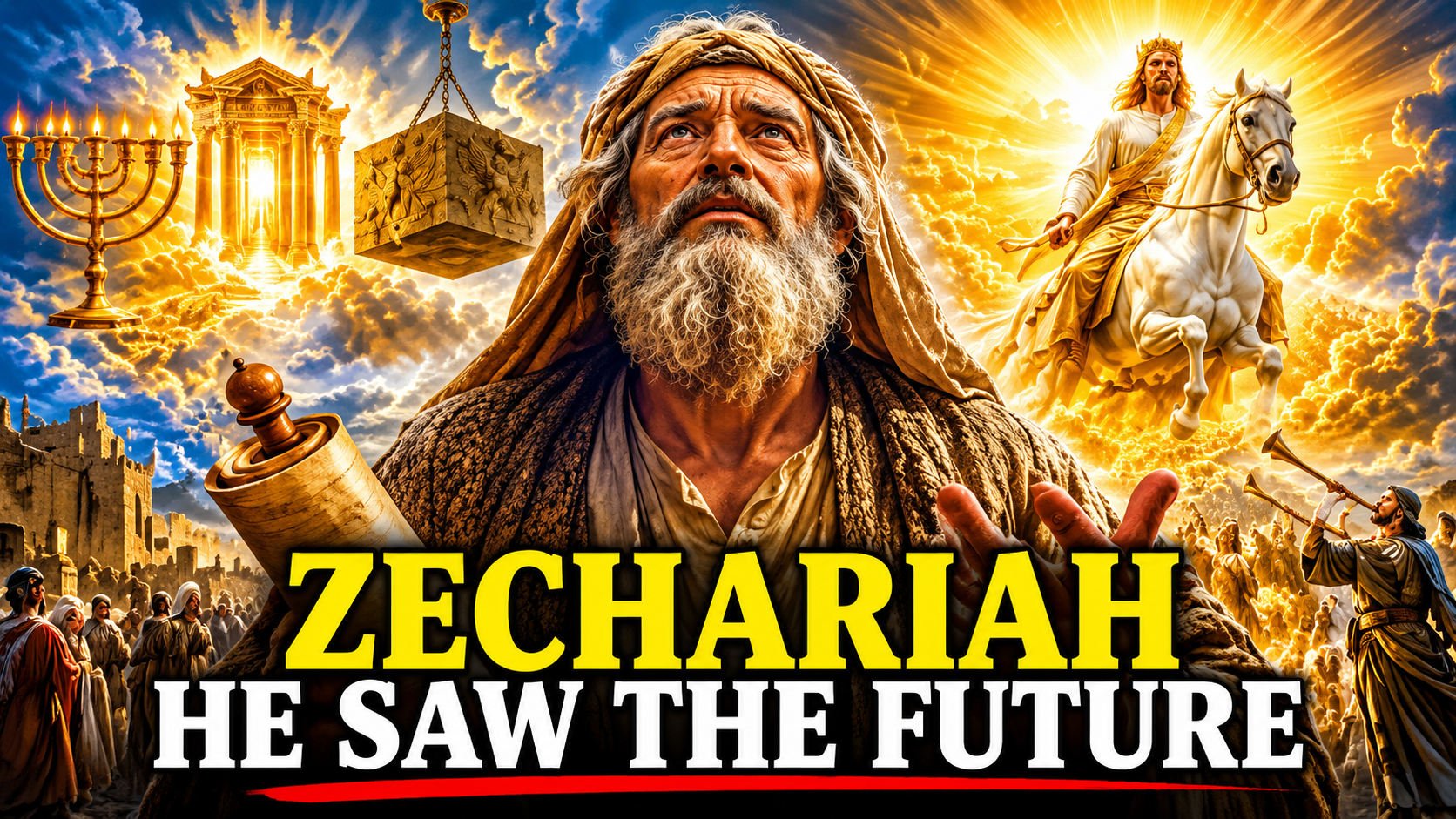
[00:08:27] His name was Zechariah. And before he ever described that distant king, he had to convince a defeated handful of people standing in the rubble that their God had never left and that the small thing they were building mattered more than they could possibly imagine.
[00:08:47] Prophets in the Hebrew Bible rarely tell you the calendar, date of their words. They speak of the reign of a king, a famine, a war, and leave the rest to memory. Zechariah is different. And the difference is the first clue to the kind of book this is. He dates himself with the precision of an administrator filing a record.
[00:09:10] The very first verse in chapter one, verse one reads, in the eighth month of the second year of Darius, the word of the Lord came to the prophet Zechariah, son of Berechiah, the son of Iddo. There is no poetry in that opening. It is a timestamp.
[00:09:28] And because the Persian kings are among the best documented rulers of the ancient world, that timestamp can be pinned to an actual month in an actual year. The second year of Darius was 520 BC. We can stand in that autumn with a confidence we almost never have. For the older prophets, it helps to know who this Darius was, because the empire Zechariah lived in had just been through an earthquake.
[00:10:01] Cyrus, the king who sent the exiles home, was dead. His son had reigned and died.
[00:10:08] And in the scramble that followed, the throne of the largest empire the world had yet seen was seized by a young officer named Darius, who took power in 522 B.C. and then spent the next two years putting down rebellion after rebellion across the provinces from Babylon to Persia to Media. Pretenders rose and were crushed.
[00:10:34] The whole structure of the known world shook and then, by about 520, went quiet again as Darius consolidated his grip. We are not guessing at this.
[00:10:47] Darius left his own account carved into a cliff face at Behistun in what is now western Iran, hundreds of feet above an old road. The Beishtun inscription is a massive trilingual relief in which Darius lists the rebels he defeated, names the provinces, and presents himself as the king the gods had chosen to restore order. It is one of the foundation documents of ancient Near Eastern history, the text that allowed scholars to finally crack the cuneiform script. And it lets us reconstruct, almost year by year, the political world humming in the background. While Zechariah began to speak.
[00:11:33] A great empire had convulsed and then settled to a small community in Jerusalem. Watching from the far western edge, it must have looked as if the whole earth had been at rest after a storm. Which is precisely the image that will open Zechariah's first vision, now place the man inside that moment. His name itself was a sermon. Zechariah means the Lord remembers.
[00:12:01] And to a people who had spent 70 years wondering whether God had forgotten them, a prophet walking around with that name was already a message before he opened his mouth. He came from a priestly family.
[00:12:15] His grandfather Iddo is listed among the heads of priestly houses who had returned from Babylon, which tells us something important.
[00:12:25] Zechariah was not an outsider shouting at the religious establishment, as some of the older prophets had been. He was inside it. He was a priest as well as a prophet. And that double identity shapes everything that follows. His visions will be saturated with priests, lampstands, altars and the temple, because the temple was his world. When he describes the cleansing of a high priest or a golden lampstand, he is describing the furniture of his own calling.
[00:12:58] He also did not work alone.
[00:13:01] Two months before Zechariah's first dated word, an older prophet named Haggai had already started hammering at the same defeated community, demanding to know how they could live in finished houses while the house of God sat unbuilt.
[00:13:17] Haggai was direct, almost gruff, focused entirely on the practical scandal of the abandoned construction site. Then Zechariah joined him. Younger and stranger, speaking in symbols and night visions. The two of them worked the same field at the same time, and the Book of Ezra remembers them as a pair.
[00:13:41] In chapter five, verses one and two, the record says now Haggai the prophet and Zechariah the prophet, a descendant of Iddo, prophesied to the Jews in Judah and Jerusalem in the name of the God of Israel who was over them.
[00:13:59] Then Zerubbabel son of Shealtiel and Joshua son of Jozadak, set to work to rebuild the house of God in Jerusalem.
[00:14:09] And the prophets of God were with them, helping them notice what that passage credits the prophets with.
[00:14:17] It does not say they predicted the future. It says they got the work moving again.
[00:14:23] The two names that will dominate Zechariah's visions, Zerubbabel the governor of the line of David and Joshua the high priest, are introduced here as the two men who picked up their tools because two prophets would not let them rest. But Zechariah's opening message was not about lumber and stone.
[00:14:45] Before any vision, before any prediction, he delivered a warning rooted entirely in the past.
[00:14:52] His first recorded oracle is a plea not to repeat the mistake that had destroyed the previous generation.
[00:15:01] In chapter one, verses two through six, he says, the Lord was very angry with your ancestors.
[00:15:08] Therefore tell the people.
[00:15:11] This is what the Lord Almighty return to me, declares the Lord Almighty, and I will return to you, says the Lord Almighty. Do not be like your ancestors to whom the earlier prophets proclaimed. This is what the Lord Almighty turn from your evil ways and your evil practices.
[00:15:35] But they would not listen or pay attention to me, declares the Lord. Where are your ancestors now? And the prophets? Do they live forever? But did not my words and my decrees which I commanded my servants, the prophets, overtake your ancestors? It is a sobering opening. He is essentially telling the survivors. The generation before the exile heard prophets too, and ignored them. And the words came true anyway. And now both the people and the prophets are dead in the ground.
[00:16:11] The only thing that outlasted them was the word of God, which arrived exactly as promised. That is the foundation he lays before he lifts anyone's eyes to the future.
[00:16:25] The God who keeps his threatening words also keeps his promising ones Are people who learn that their history was not random, that the catastrophe came because the Word was real. Are a people who can be told something astonishing about what is still to come and be expected to take it seriously. And his audience, to their credit, did take it seriously. The passage ends with the people's response, recorded in verse six.
[00:16:56] Then they repented and said, the Lord Almighty has done to us what our ways and practices deserve, just as he had determined to do. That admission is the hinge of the whole book.
[00:17:10] The community accepts that the exile was deserved and that God's word governs events.
[00:17:17] Only on that ground can the vision stand.
[00:17:21] Because the moment they agree that God's word reliably becomes history, every strange thing Zechariah is about to describe stops being decoration and becomes prophecy. The lampstands and horsemen, the crowned priest, the rejected shepherd, the pierced one, the king on the colt. He has just established the rule by which all of it must be read. The word of the Lord overtakes its hearers.
[00:17:50] It does not return empty.
[00:17:52] And on a quiet night in that same year, with the empire newly at rest and the temple still half built, that word came to Zechariah not in a sentence, but in a series of pictures that would carry the people of God far beyond anything they had asked to see.
[00:18:12] Everything Zechariah had said so far could have come from any faithful preacher.
[00:18:18] Repent. Return.
[00:18:19] Do not repeat your ancestors deafness.
[00:18:23] But on a single night, sometime around the start of 519 BC, the book turns into something far rarer. In the space of one night, Zechariah received a sequence of eight visions, one after another, each introduced by an angel who walks him through the imagery and explains what he is seeing.
[00:18:45] This is a different mode of revelation from the older prophets.
[00:18:49] It is closer to what scholars call apocalyptic, the symbolic, dreamlike, visionary style that would later flower in books like Daniel and Revelation. Zechariah stands near the headwaters of that stream, and the first four visions taken together answer the one question the discouraged community could not stop asking.
[00:19:14] Does God still see us? And does he still intend to act? The first vision opens in the dark.
[00:19:21] In chapter one, verse eight, he reports, during the night I had a vision, and there before me was a man mounted on a red horse. He was standing among the myrtle trees in a ravine.
[00:19:36] Behind him were red, brown and white horses.
[00:19:40] These are riders sent out to patrol the earth. And when they return, they make a report that would have sounded almost cruel to a people longing for upheaval.
[00:19:51] They say they have gone throughout the earth and found the au Diou, whole world at rest and in peace.
[00:20:01] Remember the political background.
[00:20:04] Darius had just finished crushing every revolt and the empire had gone calm. For Jerusalem, that calm was bad news.
[00:20:15] The exiles had hoped that the shaking of the AOR nations might mean their own restoration was breaking in, that God was about to overthrow the powers and Lift them up instead. Everything was quiet and they were still small, still surrounded, still waiting. So the angel asks the question on everyone's heart.
[00:20:38] In verse 12, he cries out, lord Almighty, how long will you withhold mercy from Jerusalem and from the towns of Judah which you have been angry with these 70 years?
[00:20:52] And the answer that comes back is the turning point of the whole night. God is not indifferent. He is jealous for Jerusalem and angry at the nations that pushed the punishment too far.
[00:21:05] In verse 16, the verdict lands.
[00:21:08] Therefore, this is what the Lord, I will return to Jerusalem with mercy, and there my house will be rebuilt and the measuring line will be stretched out over Jerusalem.
[00:21:22] The quiet was not abandonment. It was the held breath before mercy.
[00:21:29] The second vision is brief and brutal in its imagery. Zechariah looks up and sees four horns.
[00:21:37] The angel tells him, these are the powers that scattered Judah, Israel and Jerusalem, the empires and forces that had gored the people of God and flung them to the winds. A horn in Hebrew imagery is raw power, the strength of a charging animal. Four of them stand for the totality of the hostile world, pressure from every direction.
[00:22:03] But then Zechariah sees four craftsmen, four workmen coming to throw the horns down. The very powers that seemed unstoppable have their own destroyers already appointed. It is a compact theology of history in a single picture.
[00:22:18] No empire that strikes God's people is the last word. For every horn, there is already a craftsman walking toward it with a hammer. The third vision is the one that would have made the original audience catch their breath, because it describes something that on the ground, looked impossible.
[00:22:40] Zechariah sees a man going out with a measuring line in his hand, heading off to measure Jerusalem, to take the dimensions of the city so it can be rebuilt and walled. And an angel stops him.
[00:22:55] The city, he is told, cannot be measured that way. In chapter two, verses four and five, the word comes. Jerusalem will be a city without walls because of the great number of people and animals in it. And I myself will be a wall of fire around it, declares the Lord, and I will be its glory within.
[00:23:18] Sit with. How strange that promise was.
[00:23:22] The real Jerusalem of 519 B.C. was a fraction of its former size. Archaeology of the Persian period province paints a picture of a thin, struggling population.
[00:23:35] The city was underpopulated, its old walls broken, its people few enough that decades later, Nehemiah would have to draft settlers just to fill it. And into that emptiness, the vision says, you will not be able to wall this city because it will overflow with people and livestock and God himself will be the only wall it needs. A wall of fire. The promise deliberately outruns anything the returnees could imagine for themselves. It is the gap between the small thing in front of them and the enormous thing God intends. The same gap between that will eventually stretch all the way to a Messiah. But the fourth vision is the one that reaches forward in time, and it is worth slowing down for. Here the imagery leaves the landscape and enters the courtroom of heaven. Zechariah sees Joshua, the high priest, the real man who had come back from Babylon and was trying to lead worship in a half built temple, standing before the angel of the Lord, and he is not standing comfortably.
[00:24:48] Beside him stands an accuser, the Satan, the adversary. There to accuse him, Joshua is dressed in filthy garments, which in the symbolism of the vision, means the guilt of the priest and the people he represents.
[00:25:05] The accusation is real.
[00:25:08] The priesthood is compromised. The nation has a history of failure. The charge is not invented.
[00:25:16] And then God intervenes.
[00:25:18] In chapter three, verse two, the rebuke comes. The Lord rebuke you, Satan. Is not this man a burning stick snatched from the fire. Joshua is a brand pulled out of the flames, a survivor of the exile that should have consumed him. Then comes the act that the discouraged community most needed to see. The filthy clothes are stripped off and clean ones put on.
[00:25:45] In verse 4, the angel declares, see, I have taken away your sin, and I will put fine garments on you. A clean turban is placed on his head, the high priest, and through him the whole nation is cleansed. Not by his own effort, but but by divine decree. In a moment, by command. And it is right at this point, with the cleansed priests standing there in fresh garments, that the first unmistakable arrow toward the distant future is fired.
[00:26:19] God says that Joshua and his fellow priests are more than themselves.
[00:26:24] In chapter three, verse eight, the words come, listen, high priest Joshua, you and your associates seated before you, who are men symbolic of things to come.
[00:26:37] I am going to bring my servant the branch.
[00:26:41] Men symbolic of things to come.
[00:26:44] The priest in front of Zechariah is a sign pointing past himself to someone else. And that someone is given a title, the branch, A word the earlier prophets had used for a coming king from the line of David. A fresh shoot growing out of a cut down royal tree. Then God adds a promise that no single day in the temple could fulfil. He speaks of a stone with seven eyes and says in verse nine that he will remove the sin of the land in a single day.
[00:27:19] A priest cleansed in a moment, a servant called the Branch the sin of a whole land taken away in one day.
[00:27:29] The audience standing in the rubble heard a word of comfort for their own priest.
[00:27:35] But the language was already too large for him. It was reaching over his head, over the temple they were building, toward a figure who would unite the cleansing of the priest and the throne of David in one person, and who would take away sin not with the blood of bulls, but in a single day that none of them would live to see. The night was not finished. Four more visions were coming.
[00:28:04] But the door to the Messiah had just been opened in a courtroom over the head of a man in clean clothes. The night was only half over.
[00:28:15] Having seen the high priest cleansed and heard the first whisper of the branch, Zechariah's eyes were open to four more images. And the second half of the sequence turns from the cleansing of the priest to the question of power.
[00:28:31] Who would actually finish the work? Where would the strength come from to raise a temple in a province too poor and too thin to wall its own capital?
[00:28:43] The fifth vision answers that question with one of the most quoted lines in the entire Hebrew Bible. And it answers it by pointing away from everything the ancient world trusted. Zechariah is roused as if from sleep and shown a solid gold lampstand.
[00:29:01] On top of it is a bowl, and around it seven lamps with seven channels feeding each lamp. Beside the lampstand stand stand two olive trees, one on the right and one on the left. And these trees pour their oil directly into the bowl through golden pipes, so the lamps never need a human hand to refill them. It is a self feeding light.
[00:29:27] Zechariah, like a good student, asks what it means, and before the full explanation comes, the angel gives him the heart of it as a word for Zerubbabel, the governor trying to rebuild the temple.
[00:29:42] In chapter four, verse six, the message arrives. This is the word of the Lord to Zerubbabel. Not by might nor by power, but by my Spirit, says the Lord Almighty. That sentence is the theological centre of the night.
[00:30:00] The temple would not rise because the returnees were numerous or wealthy or militarily strong.
[00:30:07] They were none of those things.
[00:30:10] It would rise because the Spirit of God supplied the oil, the lampstand burning without a human refilling. It was a picture of a work sustained by God rather than by the resources of men.
[00:30:26] And then the vision turns directly to the discouragement on the ground, the way the half built foundation seemed laughably small next to Solomon's lost glory.
[00:30:36] God asks, who dares despise the Day of Small Things and promises that the same Zerubbabel whose hands laid the foundation will see it completed with a capstone brought out to shouts of grace. The two olive trees, the angel explains, are the two anointed ones who serve the Lord of all the earth, almost certainly the governor and the high priest, the civil and the priestly leaders, the same two men the book keeps pairing royal line and priestly line, standing on either side of the light of God, feeding it.
[00:31:15] Even here, in a vision about finishing a building, the architecture of the future is being sketched, two anointed offices flanking the presence of God, waiting for the one who will one day hold both at once.
[00:31:30] The sixth vision swings hard the other way, from grace to judgment. Zechariah looks up and sees a giant scroll flying through the air, and he is given its dimensions, around 30ft long and 15ft wide, the size of a banner stretched across the sky. The angel tells him this is the curse going out over the whole land, and it singles out two sins by name, the thief and the one who swears falsely by God's name. The flying scroll will enter their houses and consume them. The point is sobering and necessary. A community that has just been told its sin is removed and its work will be finished by the Spirit might conclude that anything now goes.
[00:32:21] The flying scroll says no, the restored people are still accountable. A cleansed priesthood does not mean a lawless nation.
[00:32:31] The same God who pardons also enforces, and his written word, here pictured as a scroll loosed to fly over every rooftop, will not leave dishonesty and false oaths untouched.
[00:32:46] Grace and holiness travel together through Zechariah's night.
[00:32:52] The seventh vision is the strangest to modern ears and the most theologically pointed.
[00:33:00] Zechariah sees a basket, a measuring container called an ephah, and as he watches, its heavy lead cover is lifted, and inside sits a woman.
[00:33:11] The angel names her. She is wickedness itself, evil personified, and he pushes her back down into the basket and slams the lead weight over the mouth of it.
[00:33:25] Then two more women appear with wings like a stalk, and they lift the basket between earth and sky and carry it away.
[00:33:36] Zechariah asks where they are taking it, and the answer is precise. They are carrying it to the land of Shinar, which is to say Babylonia, to build it a house there and set it on a pedestal.
[00:33:51] This is a vision of evil being deported. For generations, sin had lived in the land of Judah and dragged the people into exile. Now the picture is reversed.
[00:34:03] Wickedness is the One being boxed up, sealed and shipped east to Babylon, the very place from which the people had just returned.
[00:34:14] The land is being cleansed not only of guilt, as in the vision of Joshua, but of the active presence of evil, removed and given its own house far away, a purified land for a purified priesthood.
[00:34:32] Then comes the eighth and final vision, which closes the night by circling back to where it began.
[00:34:40] The first vision had opened with horsemen patrolling a world at rest. The last one opens with chariots.
[00:34:48] Zechariah sees four chariots coming out from between two mountains of bronze, drawn by red, black, white and dappled horses.
[00:34:59] The angel tells him these are the four spirits of heaven going out from standing in the presence of the Lord of all the earth, sent to patrol north and south and across the world. And the chariots going toward the north country, toward the direction from which Babylon and the great empires had always come down on Israel, are said to have given God's spirit rest. In that northern land, the enemy's territory is brought under control.
[00:35:32] The night that began with riders reporting an ominous calm ends with chariots establishing God's settled rule over the very lands that had threatened his people. The frame closes.
[00:35:46] The patrol of the earth, which had felt like abandonment at the start of the night, is revealed by the end to be the quiet machinery of God's sovereignty moving across the whole map. Step back and look at what one night had done. Eight visions, beginning in a dark ravine among myrtle trees and ending with bronze mountains and chariots had answered every fear the returnees carried. Does God see us? Yes. His riders cover the earth.
[00:36:20] Will the powers that crushed us go unpunished? No. Craftsmen are coming for every horn.
[00:36:27] Will the city stay small and broken? No. It will overflow beyond any wall. Is our priest too guilty to serve? No. His filth is taken and clean garments given. Where will the strength to finish come from?
[00:36:45] Not from might or power, but from the Spirit. Will sin run loose now that we are forgiven? No. The scroll flies and wickedness itself is shipped away. Is the world out of God's hands? No. His chariots patrol it from sea to sea. It was a complete reassurance, delivered in pictures to a people who had run out of confidence.
[00:37:11] But woven through it, almost quietly, were the threads that did not belong to 519 BC at all. A servant called the branch, a stone with seven eyes sin removed in a single day. Two anointed ones flanking the light of God.
[00:37:30] The visions had steadied the present.
[00:37:33] Now Zechariah would take one of those threads. The figure of the branch and do something with it in broad daylight, with a crown of silver and gold in his hands and a name on his lips that pointed centuries down the road.
[00:37:51] The visions ended with the night, but God was not finished with the figure of the branch. And the next act takes place in daylight with a real object that Zechariah could hold in his hands.
[00:38:05] Word comes to him that a delegation has arrived from Babylon exiles bringing silver and gold from the Jewish community still living in the East, a gift for the temple effort.
[00:38:17] And Zechariah is told to do something unusual with that metal.
[00:38:23] In chapter six, verses 11 through 13, the instruction reads, take the silver and gold and make a crown and set it on the head of the high priest, Joshua, son of Jozadak. Tell him this is what the Lord Almighty Here is the man whose name is the branch, and he will branch out from his place and build the temple of the Lord. It is he who will build the temple of the Lord, and he will be clothed with majesty and will sit and rule on his throne, and he will be a priest on his throne, and there will be harmony between the two. To feel why this scene is so strange, you have to understand how rigidly ancient Israel kept two officers apart. Kings came from the tribe of Judah from the line of David, and they sat on thrones.
[00:39:18] Priests came from the tribe of Levi, from the line of Aaron, and they served at altars. The two lines never merged.
[00:39:28] When a king named Uzziah once tried to burn incense in the temple, a priestly act, the Bible records that he was struck with leprosy on the spot for crossing the line. Crowns belonged to kings.
[00:39:43] And yet here Zechariah is told to make a crown, the headgear of royalty, and set it not on the governor from David's line, but on the head of Joshua the priest.
[00:39:57] A priest is being crowned, and the explanation given is not that Joshua has become king, but that he is a living sign, just as he was in the courtroom vision of someone else. The man whose name is the branch will do what no one in Israel's history had been allowed to do. He will build the temple of the Lord, and he will sit and rule on a throne, and he will be a priest on that throne. And the two officers that had been held apart for a thousand years will exist in harmony in one person.
[00:40:35] Many scholars note the interpretive tension in this passage, and some argue that the royal language originally also gestured towards Zerubbabel, the Davidic heir, standing right there. But the text, as it has Come down deliberately places the crown on the priest while speaking of a throne, and the effect is to fuse the two roles in a way no contemporary figure could satisfy. Neither Joshua nor Zerubbabel ever became a priest king.
[00:41:06] The crown was, in the end, a prophecy made of metal, and Zechariah was told to keep it in the temple as a memorial, a reminder hanging in the sanctuary that someone was still coming who would wear both.
[00:41:20] After this, the book shifts its tone. The visions and the crowning give way to a more ordinary scene, and it is precisely its ordinariness that makes it moving.
[00:41:32] Roughly two years later, in the fourth year of Darius, another delegation arrives, this time with a practical religious question.
[00:41:43] For 70 years, all through the exile, the people had observed fasts in certain months to mourn the destruction of the temple and the city.
[00:41:53] Now that the temple was rising again, they wanted to know whether they should keep mourning, should they still fast for a ruin that was being rebuilt? It is a small, human, almost bureaucratic question, and Zechariah's answer cuts straight past it to something deeper. In chapter 7, verse 5, the word comes back.
[00:42:17] Ask all the people of the land and the priests, when you fasted and mourned in the fifth and seventh months for the past 70 years, was it really for me that you fasted?
[00:42:29] God turns the question around.
[00:42:32] Your fasting, he says, was always more about you than about me. And then he reminds them what he had actually asked of their ancestors, the thing the earlier prophets had begged for and been ignored about.
[00:42:48] In chapter seven, verses nine and 10, he says, this is what the Lord Almighty said. Administer true justice. Show mercy and compassion to one another. Do not oppress the widow or the fatherless, the foreigner or the poor.
[00:43:06] The religion God wants is not a calendar of mournful fasts. It is justice for the powerless.
[00:43:14] The whole exile, Zechariah reminds them, had come because that one demand was refused. But the book does not end the conversation on a hard word. It opens out in chapter eight into one of the most tender visions of restoration in all the prophets. And here the fasting question finally gets its answer.
[00:43:35] God promises to return and dwell in the city, so that Jerusalem will be called the faithful city and its mountain the holy mountain. And then he paints a picture not of soldiers or glory, but of ordinary peace. Old men and old women will again sit in the street streets of Jerusalem, each leaning on a staff because of great age. And the streets will be filled with boys and girls playing in them. After everything, the image of salvation is the very young and the very old safe in the same streets, the elderly living to lean on their canes and children playing without fear. To a community that had buried a generation in exile, the promise that grandparents and grandchildren would fill the same streets was almost unbearable. Hope the mournful fasts God says will be turned into joyful feasts and glad festivals. Grief itself would be converted into celebration.
[00:44:40] And the chapter closes by widening the lens past Jerusalem to the whole world in a sentence that quietly anticipates everything the rest of the book is building toward.
[00:44:53] In chapter 8, verse 23, the promise reaches its horizon.
[00:44:59] This is what the Lord Almighty says In those days 10 people from all languages and nations will take firm hold of one Jew by the hem of his robe and say, let us go with you, because we have heard that God is with you.
[00:45:24] The deity nations that had scattered Judah would one day come running to grab the hem of a Jewish robe, begging to be brought along because they had heard that God was with this people. That is an astonishing reversal for a tiny province on the edge of an empire, a people who could not even fill their own city. And it is the bridge into the second half of the book. The temple would in fact be finished, completed in 516 BC, in the sixth year of Darius, exactly as Zechariah and Haggai had promised.
[00:46:03] The day of small Things ended in a dedicated house of God. But the larger promises the priest on a throne, the nations streaming in, the sin of the land removed in a single day. None of those were fulfilled. When the last stone was set, they hung over the finished temple like the crown hanging in its sanctuary, waiting. And in the chapters that follow, Zechariah stops describing the near future of his own generation and begins to describe with disturbing specificity a king who would arrive in that city centuries later, riding through a celebrating crowd on the back of a borrowed donkey.
[00:46:47] The second half of Zechariah changes character. The dated visions stop.
[00:46:53] The angel who explained everything falls silent.
[00:46:57] What follows are two long oracles, two burdens that read less like a diary of one prophet's nights and more like poetry launched far into the future.
[00:47:11] And the first of them opens not with Jerusalem but with a military road. In chapter nine, the word of the Lord marches down the map from the north, naming city after city. It falls on Hadrak and Damascus, on Hamath, on the great Phoenician ports of Tyre and Sidon, with all their wealth and their fortifications.
[00:47:36] And then it sweeps south down the coast through the Philistine cities, Ashkelon, Gaza, Ekron, Ashdod.
[00:47:46] The oracle describes a power passing through the region like a blade, and the fortified coastal cities tire, especially with its proud island stronghold being humbled. This passage has fascinated historians because the path it traces is almost exactly the path that Alexander the Great would take when he came through the Levant in 332 B.C. roughly two centuries after Zechariah. Alexander swept down from the north, and the one city that defied him was Tyre, whose island fortress he reduced only after a brutal siege, building a causeway out to it through the sea. Then he continued south down the Philistine coast, taking Gaza after another hard fight.
[00:48:35] The correspondence between Zechariah 9 and Alexander's March is close enough that it has been part of the scholarly debate over the dating of these chapters for a very long time, with some arguing the oracle anticipates the Greek conqueror and others reading it as a more general picture of judgment on the surrounding nations. Either way, the literary effect inside the book is deliberate.
[00:49:02] The oracle lets a great earthly conqueror storm down the coast, the kind of king the ancient world understood mounted power and siege engines and toppled walls. And then, having set that image in the reader's mind, it stops the conqueror at the gate of Jerusalem and announces a completely different kind of king.
[00:49:25] This is the prophecy that opened this whole story.
[00:49:29] The line we began with the king coming to daughter Zion lowly and riding on a donkey on a colt, the foal of a donkey.
[00:49:40] Now we can see what it is doing in its place. After a chapter of War Horses and falling Fortresses, the king who actually comes to Zion arrives on the least military animal imaginable. In the ancient Near East, a king was rode a horse or a chariot when he came in war, and a donkey when he came in peace.
[00:50:02] A conqueror enters a beaten city on a stallion surrounded by spears.
[00:50:08] This king enters on a young donkey, a cult that had never been ridden, the mount of a man who has nothing to prove and no one to crush. Everything about the image is calibrated against the conqueror who just swept through the the previous verses. He is called righteous and victorious, but his victory does not look like Alexander's. And the next line spells out exactly what his reign abolishes.
[00:50:36] In chapter nine, verse ten, the oracle continues. I will take away the chariots from Ephraim and the war horses from Jerusalem, and the battle bough will be broken.
[00:50:48] He will proclaim peace to the nations. His rule will extend from sea to sea and from the river to the ends of the earth. The donkey was not an accident of poverty. It was the Policy of the kingdom. This king disarms his own people, breaks the war bow, and rules the whole earth, not by conquest, but by proclaiming peace. The reach is total from sea to sea to the ends of the earth. But the method is the opposite of every empire. The oracle had just named for a people living under Persia and about to live under the Greeks and then under Rome. This was an almost impossible promise to hold onto.
[00:51:34] Kings did not come in peace. Kings came with armies, generation after generation. Read this line about the gentle kings on the donkey and waited, and no such king arrived.
[00:51:48] The temple was finished. Then centuries passed, Persia gave way to the Greeks, the Greeks to civil wars, and eventually to Rome. The Donkey King did not come.
[00:52:01] The prophecy sat in the scroll read in synagogues, copied by scribes, carried forward by a people who refused to let it go, even though nothing in their history matched it. And then, on a particular spring day at the start of the first century, in the days when Rome ruled Judea, a teacher from Galilee approached Jerusalem from the east over the Mount of Olives for the festival of Passover. According to the Gospel accounts, he stopped and deliberately sent two of his followers ahead into a village to bring back a specific animal, a young donkey, a colt that had never been ridden. He did not stumble onto a donkey. He arranged for one, and he rode it down the slope toward the city gate.
[00:52:53] The crowds swollen with festival pilgrims understood the gesture, even if they could not have cited the chapter. The Gospel of Matthew in chapter 21, verses 8 and 9 describes it.
[00:53:07] A very large crowd spread their cloaks on the road while others cut branches from the trees and spread them on the road. The crowds that went ahead of him and those that followed shouted, hosanna to the Son of David. Blessed is he who comes in the name of the Lord.
[00:53:27] Hosanna in the highest heaven.
[00:53:31] They hailed him as the son of David, the royal line. And they did it as he rode the one animal that the prophets had marked out for the coming king.
[00:53:43] Matthew, writing for readers who knew their scriptures, states plainly that this happened in order to fulfil what had been spoken through the prophet and quotes the very line about the king gentle and riding on a donkey.
[00:54:00] The man on the cult was, in the Gospel's own claim, stepping straight into a sentence written more than 500 years earlier in the ruins of a poorer Jerusalem. Whatever a person concludes about that claim, the structure of it is remarkable and worth stating precisely. A line was written down, preserved, copied, and read publicly for five centuries. It described a king arriving in Jerusalem on a particular animal in peace against the whole grain of how kings behaved, and a man arrived by his own apparent design matching it. This is the heart of why the title calls Zechariah the prophet who saw the Messiah 500 years early. The donkey was only the beginning, because the same second half of the book, the same stretch of oracles that gave the world its gentle king, also contained darker pictures of a shepherd rejected by his own flock, of a price weighed out in silver, of a leader struck down and his people scattered. And those pictures, too, would be read back into the events of that one Passover week with a precision that has unsettled readers ever since.
[00:55:21] The 11th chapter of Zechariah is one of the most difficult passages in the prophetic era. Books and even careful readers have argued for centuries about exactly what is happening in it. But its broad shape is clear and its details are unforgettable.
[00:55:40] God tells Zechariah to act out a role. He is to become a shepherd, to take up the care of a flock that is described in chillingly as a flock marked for slaughter, sheep bought and sold by traders who feel no pity for them. It is a portrait of the people of God being mishandled by their own leaders, treated as merchandise rather than as a flock to be protected.
[00:56:07] Zechariah takes two shepherd staffs and names them. One he calls favor, standing for God's gracious covenant.
[00:56:15] And the other he calls union, standing for the bond between the people.
[00:56:21] He shepherds the doomed flock for a time, and he removes worthless leaders. But the relationship sours.
[00:56:29] The flock detests him, and he grows weary of them, and the symbolic shepherding collapses. He breaks the first star favor, signaling the breaking of the covenant protection.
[00:56:42] And later he breaks the second union, signaling the fracturing of the people themselves.
[00:56:49] And then, at the center of this strange enacted parable comes a transaction.
[00:56:56] The rejected shepherd asks to be paid off to settle accounts before walking away from the flock that despises him.
[00:57:05] In chapter 11, verses 12 and 13, the scene unfolds. I told them, if you think it best, give me my pay, but if not, keep it. So they paid me 30 pieces of silver.
[00:57:18] And the Lord said to me, throw it to the potter, the handsome price at which they valued me.
[00:57:26] So I took the 30 pieces of silver and threw them to the potter at the house of the Lord.
[00:57:33] Every word in that passage carries weight, and to feel it, you have to know what 30 pieces of silver meant. It was not a random number in the law given through Moses in the book of Exodus, chapter 21, verse 32. The value of a slave who had been killed was fixed precisely. If the bull gores a male or female slave, the owner must pay 30 shekels of silver to the slave's master. 30 shekels was the going compensation for a dead slave, the price of the lowest valued life in the legal code. So when the flock weighs out 30 pieces of silver as the wage of God's shepherd, the insult is exact and deliberate. They have valued the shepherd of the Lord at the price of a gouty slave.
[00:58:25] God's own sarcastic words drive it home, the handsome price at which they valued me. And then the silver is not kept or banked. It is thrown to the potter, hurled down in the house of the Lord, in the temple itself.
[00:58:43] The detail is oddly specific. Not given away, not returned to the donors, but flung into the sanctuary and somehow connected to a potter, a maker of cheap clay vessels held inside its own century. This is a dark allegory about leaders who reject God's care and assign his shepherd a contemptible value.
[00:59:07] But the specificity of the details, the exact sum, the throwing of the silver, the temple, the potter, is what made later readers stop in their tracks.
[00:59:19] Because in the accounts of Jesus final week, those same details reassemble themselves around a single betrayal. The Gospel of Matthew, in chapter 26, verses 14 through 16, records the beginning of it. Then one of the 12, the one called Judas Iscariot, went to the chief priests and asked, what are you willing to give me if I deliver him over to you?
[00:59:46] So they counted out for him 30 pieces of silver. From then on, Judas watched for an opportunity to hand him over. There is the number again, 30 pieces of silver, the price of a slave counted out by the temple authorities for the betrayal of the shepherd.
[01:00:05] And the story does not stop there. After the arrest, Matthew tells us, Judas was seized with remorse and tried to give the money back. In chapter 27, verses 5 through 7, the rest of the pattern falls into place.
[01:00:22] So Judas threw the money into the temple and left.
[01:00:27] Then he went away and hanged himself. The chief priests picked up the coins and said, it is against the law to put this into the treasury, since it is blood money.
[01:00:40] So they decided to use the money to buy the potter's field as a burial place for foreigners. The silver is thrown into the temple, exactly as in Zechariah, and the priests, refusing to keep blood money, spend it on a field belonging to a potter. The 30 pieces, the temple, the potter, all three details from the prophet's enacted parable surface together in one sequence. Of events 500 years later, Matthew himself draws the line explicitly, and here the passage hands us a genuine scholarly puzzle worth naming honestly.
[01:01:20] In chapter 27, verses 9 and 10, Matthew writes that this fulfilled what was spoken by the prophet and then quotes the prophecy about the 30 pieces of silver and the potter's field. But Matthew attributes the words to Jeremiah, while the closest wording clearly comes from Zechariah. Interpreters have offered several explanations for this.
[01:01:46] Some note that the scroll of the prophets in that period sometimes open with Jeremiah so that his name could stand for the whole collection. Others point out that Jeremiah also has a scene involving a potter and a field he purchases, and that Matthew may be deliberately weaving the two prophets together.
[01:02:07] The difficulty is real and worth stating plainly rather than smoothing over. What is not in dispute is that the language of the 30 pieces and the potter comes from Zechariah, and that Matthew saw the betrayal of Jesus as the moment it came true.
[01:02:26] There is one more thread, and it ties the betrayal to the arrest that followed. Later in Zechariah, the image of the struck shepherd returns in an even starker form. In chapter 13, verse 7, the word comes awake. Sword against my shepherd, against the man who is close to me, declares the Lord Almighty. Strike the shepherd, and the sheep will be scattered, and I will turn my hand against the little ones.
[01:02:58] The shepherd is not merely rejected now, he is struck down by the sword, and the immediate result is a scattered flock.
[01:03:08] And according to the Gospels, on the very night of his arrest, in the garden across the Kidron Valley, Jesus quoted this exact line to his disciples. He told them that they would all fall away that night.
[01:03:22] And he said it was written that the shepherd would be struck and the sheep of the flock scattered within hours. It happened just as he said.
[01:03:32] He was seized and his closest followers fled into the dark, scattered, exactly as the prophet had written.
[01:03:41] The shepherd who had ridden in on the donkey was now the shepherd, valued at the price of a slave and struck down by the sword, his sheep running in every direction. The picture Zechariah had drawn was almost complete.
[01:03:57] A king coming in peace, then rejected, sold for the price of a dead slave, the money flung into the temple and spent on a potter's field.
[01:04:07] The shepherds struck and the flock scattered.
[01:04:12] Only one image remained, the darkest, and to the people who first read it, the most baffling of all.
[01:04:21] It was a single line about looking upon someone who had been pierced, and a mourning that would follow, and a fountain opened to wash away sin. It is the last and sharpest point of Zechariah's vision. And it brings the whole 500 year arc to the foot of a Roman cross.
[01:04:41] Everything in Zechariah's second half has been moving toward a single, almost unbearable image. And in chapter 12, it finally arrives.
[01:04:51] God speaks of a day when he will pour out his spirit on Jerusalem, a spirit of grace and of prayer. And in that moment the people will see something that breaks them open.
[01:05:04] In chapter 12, verse 10, the words come and I will pour out on the house of David and the inhabitants of Jerusalem a spirit of grace and supplication.
[01:05:18] They will look on me, the one they have pierced, and they will mourn for him as one mourns for an only child, and grieve bitterly for him as one grieves for a firstborn son.
[01:05:32] Read that sentence slowly, because it contains a mystery that Jewish and Christian interpreters alike have wrestled with for 2000 years. God is speaking in the first person. I will pour out, and then in the same breath the people look on me, the one they have pierced. The speaker is God. And yet the one pierced is somehow also God looked upon, mourned over like an only son, like a firstborn child who has died.
[01:06:07] How can the unpierceable God be the pierced one? The grammar itself seems to strain toward a figure who is both divine and able to be wounded. And the grief that follows is the deepest grief a family can know, the loss of an only child. And the very next line tells what that piercing accomplishes.
[01:06:29] In chapter 13, verse 1, the promised lands.
[01:06:33] On that day a fountain will be opened to the house of David and the inhabitants of Jerusalem to cleanse them from sin and impurity.
[01:06:43] Recall what God had said back in the courtroom vision, that he would remove the sin of the land in a single day. Here that single day arrives, and it is tied to the pierced one. A fountain opens, and the sin and impurity of the people are washed away.
[01:07:01] The mourning over the pierced figure and the cleansing of the nation are the same event. The wound and the washing belong together.
[01:07:10] For the Gospel writers, this was the final piece. They had watched a man ride in on a donkey, be sold for 30 pieces of silver. See that silver thrown into the temple and spent on a potter's field, and be struck down, so that his followers scattered.
[01:07:29] And then they watched him die on a Roman cross. The Gospel of John records a detail that the other accounts do not dwell on. After Jesus had died, a soldier, to confirm the death, drove a spear into his side. In chapter 19, verse 34, John writes instead, one of the soldiers pierced Jesus side with a spear, bringing a sudden flow of blood and water.
[01:07:56] And John, who structures his entire account around the fulfillment of Scripture, immediately points to where that act had been written down.
[01:08:05] In chapter 19, verse 37, he says simply, and as another scripture says, they will look on the one they have pierced, he is quoting Zechariah, the line about the pierced one written five centuries earlier. In a prophecy about mourning and and a cleansing fountain, John attaches directly to a spear thrust on a hill outside Jerusalem. The same gospel notes that blood and water flowed from the wound. And Christian readers have long heard in that detail an echo of the fountain opened to cleanse from sin.
[01:08:44] Now this is exactly the point where a careful listener should ask the hard question.
[01:08:51] Is it not possible that the Gospel writers simply invented these events to match the prophecies, working backward from Zechariah to construct a story?
[01:09:02] It is the most important objection, and the answer is where archaeology earns its place. In this account, we know beyond reasonable dispute that the book of Zechariah existed in its current form long before Jesus was born. Among the Dead Sea Scrolls, the library hidden in caves near the shore of the Dead Sea and discovered in the middle of the 20th century are copies and fragments of the minor prophets that include Zechariah, some of them dating to well over a century before the Christian era. A Greek scroll of the minor prophets record covered from the same region, preserves these chapters in a pre Christian text. The prophecies of the donkey king, the 30 pieces of silver, the struck shepherd and the pierced one, were demonstrably written down, copied and circulating among the Jewish people generations before the events the Gospels describe. Whatever one concludes about the fulfillment, the sequence cannot be reversed.
[01:10:10] The target was painted first, centuries first. And it was painted by a hand that had no way of knowing where the arrow would land. This is also why among all the prophets, Zechariah casts such a long shadow over the accounts of Jesus final week, the concentration is remarkable.
[01:10:33] From a single prophetic book come the king on the colt, the wage of 30 silver pieces, the money flung into the temple, the potter, the shepherd struck and the flock scattered, and the pierced one mourned like an only son.
[01:10:50] Few prophetic books are woven so densely into the passion. And the book's reach does not stop at the cross.
[01:10:58] Its imagery surges back up in the last book of the Bible, where the vision of all peoples looking upon the pierced one returns, where lampstands and olive trees and horsemen ride again through the book of Revelation.
[01:11:14] Zechariah, the priest from the rubble became one of the deepest wells the New Testament drew from.
[01:11:22] But the prophet himself did not end his book at the piercing. His final chapter lifts past the wound to a horizon that in the Christian reading is still ahead, even now. Chapter 14 describes the day of the Lord, a day of upheaval and then of dazzling resolution when God himself comes to stand on the earth.
[01:11:46] In a detail that has struck every reader who knows the geography of the city, the prophet names the exact spot.
[01:11:55] In chapter 14, verse 4, he writes that on that day the feet of the Lord will stand on the Mount of Olives east of Jerusalem, the very ridge over which the king had ridden on the donkey. And the mountain will split in two, and the chapter rises to a final note of unbroken unity.
[01:12:16] In chapter 14, verse 9, it declares, the Lord will be king over the whole earth.
[01:12:24] On that day there will be one Lord and his name, the only name. That is where Zechariah ends, not at a grave, but at a throne over the whole earth, the same universal reign the Donkey King had been promised when the war bough was broken and peace proclaimed to the nations. Stand back now and look at the whole span we began among broken stones with a discouraged handful of returnees laying a foundation in tears and a young priest with a name that meant the Lord remembers. He spoke to people who could not even fill their own small city, and he told them to keep building a temple that would never rival the one they had lost.
[01:13:13] By every earthly measure, he was a minor figure in a minor province on the rim of someone else's empire.
[01:13:22] And yet threaded through his visions in the dark and his oracles in the daylight was the most detailed portrait of a coming messiah that any single prophet would leave behind.
[01:13:34] The gentle king on the colt, the price of a slave counted out in silver, the coins thrown to the potter in the house of God.
[01:13:44] The shepherds struck and the sheep scattered. The pierced one mourned like a firstborn and the fountain opened to wash away sin. Each detail set down 500 years early, copied and carried by a people who kept waiting through Persia and Greece and Rome until a week in Jerusalem when, one after another, the pictures stepped out of the scroll and into the streets. That is why this prophet, of all of them is remembered as the man who saw the Messiah five centuries before he came.
[01:14:20] He saw him from the rubble and he wrote down what he saw.