Episode Transcript
[00:00:00] Picture a man who has spent his life reading and writing about God, who has seen war, exile and loss. He stands by a great river when something arrives and his body simply quits.
[00:00:13] The color drains from his face. His knees give out. He goes down onto his hands, then flat on the ground, forehead in the dirt, unable to speak. The people with him do not even see what he sees, but they feel enough to run and hide. This is not a man overwhelmed by beauty. This is a man whose nervous system is overloaded by contact with something his language cannot hold.
[00:00:41] Across the Bible, from Genesis to Revelation, this is the ordinary reaction to meeting one of these beings. Not tears of comfort, not a warm glow collapse.
[00:00:54] Now set that beside the picture most of us carry in our heads. A plump baby with tiny wings and a bow, hovering over a valentine. A serene blonde woman in a flowing robe. A hand on a sleeping child.
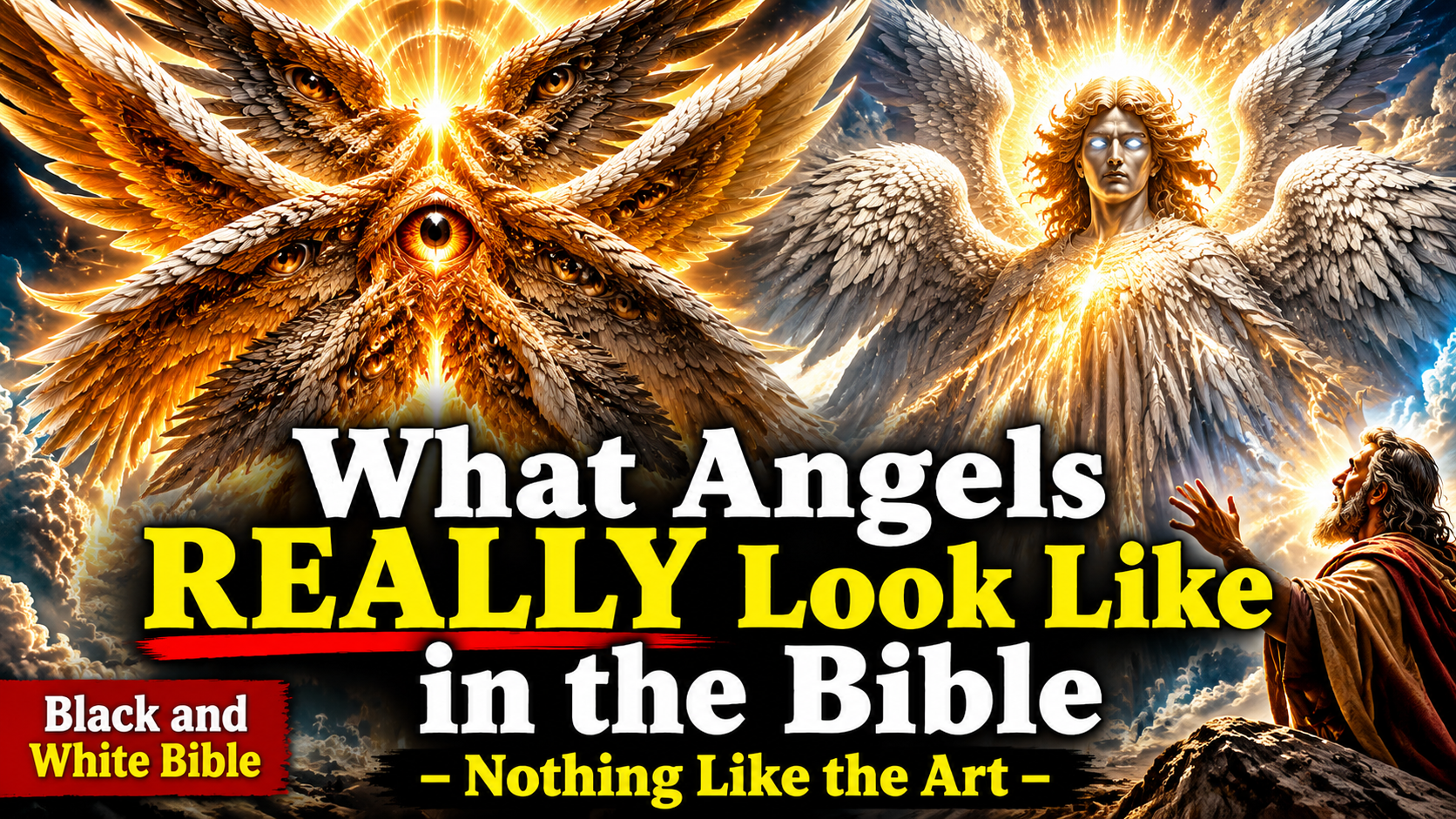
[00:01:09] A soft, glowing figure of comfort. That image is everywhere. Stained glass, greeting cards, Christmas trees, tattoos, hospital chapel walls. It is one of the most recognizable images in all of Western culture, and it has almost nothing to do with what the biblical text actually describes. The gap between the art and the words on the page is not small, it is enormous.
[00:01:37] Often the exact opposite. Where the art gives us something to hold, the text gives what makes grown prophets fall on their faces.
[00:01:47] This is what this video is about. Not the angels of Renaissance ceilings, but the angels of the text.
[00:01:55] The guardians with flaming swords, the burning ones with six wings.
[00:02:01] The four faced creatures moving beside wheels that are full of eyes. The messengers who look so much like ordinary men that you could share a meal with one and never know. We walk through the actual descriptions in order, from the Garden of Eden to the throne room of Revelation, and by the end, the reassuring figure on the greeting card is going to look like what it really is.
[00:02:28] A very late, very human invention laid over the top of something far stranger and far older. To do that, honestly, we have to start with a word, because the whole confusion begins with a word. In English, we say angel and hear a kind of creature, a species like dog or eagle, a specific shape. But that is not what the underlying words mean.
[00:02:55] In Hebrew, the word is malak. In Greek, it is angelos. And both of them mean simply messenger. They describe a job, not a body.
[00:03:07] A malak is one who is sent. One who carries a message from a sender to a recipient. The Bible uses the word for human messengers, too.
[00:03:17] Ordinary men sent from one king to another. So when the text calls one of these beings an angel, it is not telling you what it Looks like it tells you what it is doing. It is on an errand.
[00:03:31] That fact changes how you read every description, because it means the Bible is not describing one kind of being with wings and a robe. It describes a whole range of beings, some like fire, some like animals fused together, some so completely human they can sit and eat, all doing the same job of carrying God's word into the world. The shape is not the point, the sending is the point.
[00:04:01] The word angel flattens that variety into one picture, which painters filled with the softest thing. The text never agreed to that.
[00:04:11] The New Testament writers assumed this range without pausing to explain it. In Hebrews 13, verse 2, the author writes, do not forget to show hospitality to strangers, for by so doing some have shown hospitality to angels without knowing it.
[00:04:30] Sit with. How strange that is. It only works if angels look just like a tired traveller at your door.
[00:04:37] You cannot host a glowing winged baby. You can easily host a dusty man asking for a place to sleep.
[00:04:45] And sometimes that man is not a man at all. The warning assumes a messenger so ordinary that the only way you find out is afterward, if at all. At the same time, the New Testament insists these beings are not minor decorations in the world. In Colossians 1:16, Paul writes of for in him all things were created in heaven and on earth, visible and invisible, whether thrones or powers or rulers or authorities.
[00:05:19] Those words are ranks of beings, not vague poetry.
[00:05:24] These were understood as ranks of invisible beings, a whole population of the heavens. The Bible assumes reality is crowded behind the visible world, a whole layered, ordered creation, and that the messengers who occasionally break through into human sight are only the part of it we ever glimpse. And what are they in the end?
[00:05:48] The book of Psalms gives the cleanest one line answer. Psalm, chapter 3, verse 20.
[00:05:54] Praise the Lord, you his angels, you mighty ones, who do his bidding, who obey his word. And both of them cut against the greeting card image first. They are mighty ones. The Hebrew points to strength, to force, not softness.
[00:06:12] And they exist to do his bidding and obey his word. They are not free floating spirits drifting through the clouds to keep us company.
[00:06:21] They are under orders. When one of them appears, it is because it has been sent, and it will do exactly the thing it was sent to do, whether that is to announce a birth or to guard a gate or to level a city. The comfort you feel before the greeting card angel comes from imagining a being that exists for you.
[00:06:44] The biblical messenger exists for God and simply passes through your life on the way to carrying out a command.
[00:06:52] Hold those three ideas together.
[00:06:55] The Messengers can be hidden, walking among us as strangers. They belong to a vast, ordered, invisible creation, and they are mighty instruments of a will not ours. None of that matches a chubby infant with a bow.
[00:07:11] So the honest question is not why the angels look so scary.
[00:07:16] It is where the soft version came from and what did it paint over?
[00:07:21] To answer that, we have to go back all the way back to the first time one appears, standing at a garden's entrance with a weapon that turns every way. Because the first angel in the Bible is not there to comfort anyone.
[00:07:38] It is there to keep us out. The first of these beings does not float and does not sing. It stands at a gate with a blade. At the end of Genesis 3, after the man and woman are driven out, the text says in verse 24, after he drove the man out, he placed cherubim east of Eden and a flaming sword to guard the tree of life.
[00:08:04] The angelic debut, not a lullaby over a manger, a sentry at a border, with a weapon that moves on its own, set to make sure what was lost stays lost. The very first thing an angel does in the Bible is bar the door and notice the name the text uses, not angel this time. Cherubim.
[00:08:27] That word is going to matter for the rest of this story, because the cherub is the single clearest example of how far the popular image has drifted from the text.
[00:08:40] Say cherub today, and almost everyone pictures a fat, rosy baby or a baby's head with a pair of little wings, the kind of thing painted in the corner of a ceiling to fill space so fixed that cherubic means babyish.
[00:08:57] But Genesis cherubim guard the world's most dangerous threshold, stationed with a sword of fire.
[00:09:05] Nothing about them is babyish.
[00:09:08] They are the reason the way back is shut. The Hebrew Keruv belongs not in a nursery, but in the throne rooms and gates of the ancient Near East. Scholars connect it to the Akkadian caribou, protective beings that guarded sacred space in Mesopotamia. In the palaces of that world, archaeologists find what a cherub was.
[00:09:32] Not infants, but composite creatures, enormous winged beasts carved in stone, set at doorways to guard them. The most famous are the Lamassu of Assyria, great figures with a bull or lion's body, an eagle's wings, and the face of a bearded man standing five metres tall at a palace gate. So anyone coming to the king passed between two of them. That is the cultural furniture the word cherub comes out of. Winged, hybrid, powerful, and posted at the door. Israel's neighbors imagine the guardians of holy Places as winged sphinxes.
[00:10:14] The Bible reaches for that image. We do not have to guess at this, because it is confirmed inside Israel's own artifacts. Excavations at Megiddo turned up a famous set of carved ivories, one showing a king seated on a throne. And the sides of that throne are winged sphinxes, creatures with a lion's body, wings, and a human face. The throne is literally supported by the same kind of being the Bible calls a cherub. At Ugarit, texts show the High God enthroned, flanked by these winged guardian creatures. Across the region, the seat of a God or king is carried and guarded by winged hybrid beings. So when the Bible describes the cherubim, it is not inventing a private fantasy. It draws on an image its first audience already knew by sight and does something remarkable with it. Because after Eden, the cherubim reappear in the most important object Israel ever built. When God gives Moses the design for the Ark of the Covenant In Exodus 25, the instructions are precise. Verses 18 through 20 and make two cherubim out of hammered gold at the ends of the COVID Make one cherub on one end and the second on the other of one piece. With the COVID at the two ends, the cherubim are to have their wings spread upward, overshadowing the COVID with them. The cherubim face each other, looking toward the COVID Two golden guardians, wings over the ark's lid, facing inward over the place where God would meet Israel.
[00:12:03] Then in verse 22, God tells Moses what it is for above the COVID between the two cherubim that are over the Ark of the Covenant Law, I will meet with you and give you all my commands for the Israelites.
[00:12:18] Stop and see what that means. The same being that guarded Eden with a flaming sword is now cast in gold and set over the ark.
[00:12:29] And the space between their wings becomes the throne in Eden. The cherubim kept humanity from God's presence over the ark. They mark the one place that presence comes near again under extreme holiness and danger. The guardians of the closed door become the frame of the reopened meeting place. The same creature, the same job, guarding the line between human and holy on both sides of the story.
[00:13:00] This is why one of the oldest titles for the God of Israel is built directly out of these beings. In 1st Samuel 4, when the ark is carried into an Israelite camp, the text says in verse four, the people brought the ark of the Lord Almighty, who is enthroned between the cherubim. That phrase appears again and again through the psalms and the histories. The invisible God is pictured as a king whose throne's armrests and sides are living guardian creatures.
[00:13:34] Exactly. The throne carved at Megiddo, the seat flanked by winged beings at Ugarit. Except the seat is empty because the king who sits there cannot be carved.
[00:13:47] The cherubim are the throne. They carry the presents. They are not decoration on the furniture of worship.
[00:13:54] They are the framework of God's own royal seat on Earth. That shows how far the baby cherub has fallen.
[00:14:03] The being the Bible calls a cherub is not a symbol of innocence. It is a symbol of guarded, lethal holiness.
[00:14:12] The creature at the threshold you are not allowed to cross. The creature whose wings form the seat of a king so holy that men die for merely touching the ark it guards.
[00:14:24] Somewhere along the way, the west took that word guardian of Eden, golden sentinel over the ark, the word for the living throne of God, and pinned it onto a plump infant with a bow. It is hard to imagine a fuller inversion.
[00:14:42] The guardian of the flaming sword became a Valentine's mascot. But at least the cherubim are recognizably strange. You look at a winged sphinx and you know you are seeing something that does not belong to the ordinary world. The next kind of messenger is harder and in a way, more unsettling, because it hides the strangeness completely.
[00:15:05] For all the times the Bible shows us beings of fire and wings and hybrid faces, just as often it shows a messenger with no strangeness at all.
[00:15:16] One who walks the road, sits in the shade, accepts a meal, and is taken by everyone who meets him. For an ordinary man, those are the angels you could never paint, because there is nothing to paint.
[00:15:31] And they are where we turn next. There is a kind of angel no painter has ever captured for a simple reason. There is nothing to paint. No wings, no glow, no flaming sword, no hybrid face. Just a man, a traveler on the road, a stranger at the gate, someone you would pass without a second glance. This is the most common way messengers appear in the oldest scriptures, the one the greeting card image erases because it cannot become decoration.
[00:16:05] You cannot hang a picture of an angel who looks exactly like anyone else. But the text insists this is how they came.
[00:16:14] It happens first, unforgettably, at the great trees of Mamre. In Genesis 18, an old man named Abraham sits at the entrance of his tent. In the heat of the day, the text says, in verses 1 and 2, the Lord appeared to Abraham by the trees of Mamre. As he sat at his tent in the heat of the day, Abraham looked up and saw three men standing nearby. When he saw them, he hurried from his tent to meet them and bowed low to the ground.
[00:16:49] Three men standing nearby.
[00:16:52] That is what Abraham sees. Not a vision in the sky, not a chorus of light.
[00:16:57] Three travelers close enough that he can run to them. And what he does next is the most ordinary thing in his world.
[00:17:06] He offers hospitality. He has water brought for their feet, has bread baked, has a calf prepared. And then, the text says, he stands under the tree while they eat. These beings sit in the shade of a tent and eat a meal of curds and milk and roasted meat. There is no hint from outside that they are anything but three tired men on a journey.
[00:17:32] And yet they are not. One speaks with an authority belonging to God alone, promising the aged Sarah a son within a year, and then turning to confront Abraham about the cities on the plain below. The reader learns what Abraham only slowly realizes. He has been hosting the divine at his own table. This is the scene behind that warning in Hebrews about entertaining angels, unaware it is not a metaphor. The memory of Mamre. Three strangers who were messengers, welcomed as men, revealed only by what they said.
[00:18:12] Then two of those three walk on down towards Sodom, and the disguise holds even under pressure. Genesis 19 opens in verse one.
[00:18:23] The two angels arrived at Sodom in the evening, and Lot sat in the city gateway. He rose to meet them and bowed with his face to the ground.
[00:18:34] The narrator calls them angels because the narrator knows what they are, but the people of the city do not.
[00:18:42] To everyone in Sodom, they are simply two men, visitors who have come to spend the night. The mob that gathers at Lot's door treats them as men, demands them as men. Only inside does their nature break through when they pull Lot to safety and strike the crowd with blindness. Right up until that moment, the total human disguise is airtight. You could stand in the street and shout at one of these beings, never suspecting it was a messenger of God. The pattern repeats across the whole early history, and it grows stranger each time. In Genesis 32, Jacob is left alone at night by the ford of the jabbok. And the text says in verse 24, so Jacob was left alone, and a man wrestled him till daybreak.
[00:19:36] A man written in that flat physical word. Jacob wrestles no spirit or light. He grapples all night, hip to hip, with what reads as a human being. Only when his opponent wrenches his hip with a touch and refuses his name does Jacob grasp what he fought and that he has, as he says, seen God face to face and lived. The messenger came so ordinary that Jacob could physically fight it. That is how complete the disguise is. It is there again, on the eve of Israel's great battles, in the fifth chapter of Joshua, just before the fall of Jericho, Joshua looks up and sees once more a man. Joshua. 5:13.
[00:20:23] When Joshua was near Jericho, he looked up and and saw a man before him with a drawn sword. Joshua went up to him and asked, are you for us or for our enemies?
[00:20:35] Neither, he replied, but as commander of the army of the Lord, I have come.
[00:20:41] Then Joshua fell face down to the ground and asked him, what message does my lord have for his servant?
[00:20:49] The commander replied, take off your sandals, for the place where you stand is holy.
[00:20:57] Joshua had challenged him like any armed stranger on the road.
[00:21:01] Are you one of ours or one of theirs? The answer refuses the question. And the ground turns out to be holy.
[00:21:09] The same command once given to Moses. But the first impression was a man with a sword.
[00:21:16] The strangeness stayed hidden until it chose to speak. Sometimes the human likeness is so convincing that people only realize afterward, and it terrifies them. In Judges 13, a messenger comes to the wife of a man named Manoah to announce the birth of Samson. She runs to tell her husband, and the way she describes the visitor is telling. Verse 6.
[00:21:43] Then the woman went to her husband and told him, a man of God came to me. He looked like an angel of God, very awesome. I did not ask where he came from, and he did not tell his name.
[00:21:57] A man of God.
[00:21:59] Her first thought, only his bearing, something awesome and unplaceable about him, made her reach for the word angel at all. And even then she does not truly know until later in the story when the visitor rises in the flame of their altar sacrifice and Manoah cries out that they will surely, surely die. Right up to the fire they took him for, a man of God, a prophet, a human holy man passing through. Put all of these together and a clear picture forms a picture completely unlike the winged figure of the art. The most frequent way a messenger of God appears in the oldest scriptures is with no supernatural marks at all. As a traveler you would feed, as a stranger you would argue with.
[00:22:49] As a man you could wrestle to the ground. The concealment is the point. They move through the world in perfect disguise, and the strangeness shows only in what they say and know and what they do at the moment of their choosing. This is why the Bible can warn ordinary people that the guest at their table might be one of them. It is not asking you to look for wings. It is telling you that you would not be able to tell. But there is a thread inside these scenes more disorienting than any, and the careful reader notices it early. In several scenes, the man does not merely speak for God, he speaks as God. He accepts worship. He gives his name as the divine name, or refuses to give any name at all.
[00:23:41] The line between the one sent and the one who sends begins to blur until at times it disappears entirely. That figure has a title of his own in the Hebrew Bible.
[00:23:54] The angel of the Lord. And untangling who or what he is has occupied readers for more than 2,000 years.
[00:24:03] That is where we go. Somewhere in these appearances, a seam opens and that the earlier scenes only hinted at. A messenger arrives. And then, without warning, the messenger is speaking in the first person as God himself.
[00:24:20] Not the Lord says, but I am the Lord.
[00:24:24] He receives worship no ordinary angel is ever allowed to receive. He gives promises only God can keep.
[00:24:33] The Hebrew text marks this figure with a specific title. Malak yhwh.
[00:24:40] The angel of the Lord, or the messenger of the Lord. The single most puzzling being in the Hebrew Bible. At the moment you are sure he is a created servant standing in for God.
[00:24:53] The text calls him God to his face. The clearest place to watch it happen is at the burning bush. In Exodus 3, Moses keeps his flock at the far edge of the wilderness.
[00:25:06] When something catches his eye. The text says verses two to four, the angel of the Lord appeared to him in flames of fire from within a bush. Moses saw that though the bush was on fire, it did not burn up. So Moses thought, I will go over and see this strange sight.
[00:25:27] When the Lord saw that he had gone over to look, God called to him from within the bush. Moses. Moses read those two verses slowly.
[00:25:38] In verse two, it is the angel of the Lord who appears in the fire. By verse four, it is the Lord who sees and God who calls out from the same bush. The angel of the Lord and God have become, in the space of two sentences, the same speaker in the same flame. And then in verse 6, the voice says, I am the God of your father, the God of Abraham, the God of Isaac, and the God of Jacob.
[00:26:09] At this, Moses hid his face, afraid to look at God. Not afraid to look at an angel, afraid to look at God. The messenger in the fire has spoken as the God of the fathers. And Moses covers his eyes.
[00:26:24] No slip of language. It is a consistent feature of this figure, and it appears early back in Genesis 16. A pregnant, mistreated slave named Hagar has fled into the desert and is found by A spring. It is the angel of the Lord who finds her, the angel of the Lord who tells her to return, the angel of the Lord who promises that her descendants will be too numerous to count. Then in verse 13 comes the line that has stopped readers for millennia.
[00:26:58] She named the Lord who spoke to her, you are the God who sees me, for she said, I have now seen the one who sees me.
[00:27:08] Hagar does not call him an angel.
[00:27:11] She names him the Lord, the God who sees, marveling that she has seen him and lived.
[00:27:18] From her side she has met God. The narrator introduced the figure as the angel of the Lord.
[00:27:25] Hagar walks away, having spoken with God himself. The two descriptions sit on top of one another, and the text does nothing to pull them apart. And yet the title itself insists on a distinction.
[00:27:40] He is the messenger of the Lord. A messenger is by definition sent by someone else. He is not the sender. So the same being who speaks as God is also in the very name the text gives him, someone dispatched by God. He is both the one who says, I am the Lord, and the one who has been sent from the Lord. He carries the divine presence and authority so fully that meeting him is meeting God, while somehow remaining distinct from the one who sent him.
[00:28:15] He stands on the line between heaven and earth, falling to neither side. You can see why this figure was so useful and so necessary in the story of the Exodus, where God has to be present with a whole nation on the move without being contained or approached carelessly. In Exodus 14 at the sea, with Pharaoh's army bearing down, the text tells how Israel was protected that night.
[00:28:44] Verse 19, the angel of God, traveling in front of Israel's army, withdrew and went behind them. The pillar of cloud also moved and stood behind them.
[00:28:56] The angel of God and the cloud move as one reality, the visible presence of God guarding his people, going before them, then standing between them and the enemy. The messenger and the presence are not two things.
[00:29:13] They are the same nearness of God seen from two angles. For readers ever since, this figure has been the great puzzle, and the answers have divided along deep lines. In the world of early Judaism, the sheer boldness of a being who speaks and is worshipped as God, while somehow remaining distinct from the God of Israel, was recognized and debated intensely.
[00:29:40] Alan Siegel wrote a landmark study of this problem, its title naming the danger Two Powers in Heaven. He traced how some came close to speaking of a second divine figure beside God and how the rabbis, alarmed at where that could lead, eventually condemned the two powers, reading as heresy the very existence of that controversy tells you how real the tension in the text is. Readers of the Hebrew Scriptures kept meeting a figure who seemed to be God and beside God at once, and they argued for centuries about what to do with him. From the same soil grew traditions of an exalted angel, sometimes called Metatron in the mystical texts, a being said to bear the divine name and to sit in the presence of God.
[00:30:35] An attempt in its way to give a place to this uncomfortable second presence.
[00:30:41] Christian readers took the puzzle a different direction. From early on, many read the angel of the Lord who appeared in the fire, found Hagar, wrestled Jacob, who stood before Joshua the Ditt as the pre incarnate son, the word who would later be born at Bethlehem, showing himself in advance across the pages of the Old Testament. On that reading, he speaks as God, yet is sent from God because he is both fully divine and fully sent. The reformers largely continued this line and you still find it defended today.
[00:31:24] Others insist he is simply an angel who so fully represents God that to meet the envoy is to meet the king, the way a royal envoy in the ancient world spoke with the full authority of the throne in the first person, as though the king stood there.
[00:31:44] The Bible never settles the argument, and that restraint is worth respecting. What the text insists on is the effect when the angel of the Lord appears. People react as if seeing God. They fall down, they hide their faces, they are amazed to be still breathing. Whatever this figure is, he carries the weight of divine presence, and the human body responds by collapsing. Which brings us back to the thread we started with that reaction. The falling, the fear, the loss of strength is not reserved for this one mysterious messenger. It is what happens whenever the true nature of these beings breaks through into human sight. And nowhere does it break through more openly than in a temple where a prophet looks up and sees God's throne ringed by beings of fire, shaking the doorposts with a single word. That is where we go next. In the year that a king died, a man walked into the temple and saw the room behind the room. Isaiah, a prophet in Jerusalem, records it in the sixth chapter of his book. One of the few places in scripture where a human is allowed to look directly at God's throne and describe it. What he saw was not a choir of gentle figures in white.
[00:33:07] It was fire that could speak. Verses 1 through 3 in the year that King Uzziah died, I saw the Lord high and exalted, seated on a throne, and the train of his robe filled the temple. Above him was seraphim, each with six wings, two covered their faces to their feet, and two were flying. And they called to one another, holy, holy, holy is the Lord Almighty.
[00:33:37] The whole earth is full of his glory. Almost everything cuts against the familiar image.
[00:33:44] First, the wings. Not one pair, but three. Six on each. And notice how the wings are used.
[00:33:52] Only one pair is for flight. The other four are for covering. With two wings they cover their faces, and with two they cover their feet. These beings stand in the immediate presence of God, closer to the throne than anything else in the vision. And even they will not look directly at what they serve.
[00:34:15] Even the seraphim shield their faces. The greeting card angel gazes serenely outward, making eye contact, offering comfort. The seraphim hide their own eyes in the presence of a holiness too great to face. If the beings nearest to God cover their faces before him, that tells you what kind of presence this is and how far the real throne room stands from casual reassurance.
[00:34:42] And what are they doing?
[00:34:44] They are not resting. They are not watching over a sleeping child. They cry out ceaselessly, one to another, holy, holy, holy.
[00:34:54] In Hebrew, tripling a word is a superlative new name. Then to say something three times is to push it to the absolute limit the language can reach. The seraphim are not describing God as very holy or especially holy. They declare him holy to a degree that breaks the grammar beyond any comparison. The human tongue can build, and the sound of it is physical. Verse 4. At their voices, the doorposts shook and the temple filled with smoke.
[00:35:30] Their voices shake the stone. The foundations of the temple tremble at the noise these beings make simply by speaking the truth about God. This is not singing you would want playing softly in a hospital chapel. This is a sound that makes the architecture shudder and fills the sanctuary with smoke.
[00:35:52] And now the name itself.
[00:35:55] The Hebrew is seraphim, from a root meaning to burn.
[00:35:59] A seraph is literally a burning one.
[00:36:03] Not pale, cool figures of light.
[00:36:06] They are creatures of fire, named for burning. Standing in flame around a throne. The word carries heat and danger in its very letters. And here is the detail that unsettles readers most.
[00:36:20] That same word, seraphim, is used elsewhere for serpents. In numbers, the deadly snakes sent among the people in the wilderness are called seraphim, burning ones, most likely, for the burning of their venom. Numbers 21:8.
[00:36:39] God tells Moses, make a snake and put it up on a pole. Anyone who is bitten can look at it and live.
[00:36:48] So Moses made a bronze snake and put it up on a pole. Then when anyone was bitten by a snake and looked at the bronze snake, they lived the burning serpent lifted on the pole, and the burning ones around the throne share a name. Fire and serpent are woven into the very word for these highest attendants of God. Whatever they looked like, the language ties the seraphim to something fiery and serpentine, not soft infants. This is less strange than it sounds, because Isaiah's world already had a visual vocabulary for exactly this. In the near east, especially Egypt, the winged upright serpent was a sacred symbol of divine protection. The uraeus, the rearing winged cobra, sat on the pharaoh's brow, guarding thrones as a fierce, fierce, fiery guardian. And this imagery did not stay in Egypt. In Judah, archaeologists found seals and impressions, small carved stamps for marking property depicting these Winged Serpents. 4 and 6 Winged Uraei used by Judean officials in the prophet's era. The people who first heard Isaiah describe the seraphim were not baffled.
[00:38:09] They had seen winged fiery serpents in clay and stone all their lives as emblems of guardianship. Isaiah takes that image, the winged burning serpent guardian, and sets it glorified around God's throne. Now put yourself where Isaiah stands, a prophet, a righteous man who has spent his life speaking for God. And his reaction to seeing this is not wonder, and it is certainly not comfort. It is ruin. Verse 5. Woe to me. I cried. I am ruined. For I am a man of unclean lips, and I live among a people of unclean lips.
[00:38:52] And my eyes have seen the king, the Lord Almighty.
[00:38:57] The Word is undoing.
[00:38:59] Isaiah feels himself coming apart, confronted with the holiness these creatures shield their faces from. He feels his own impurity unbearably. And his first thought is that he is finished, that a man like him cannot survive having seen this. This is the same reaction we keep meeting, the collapse, the sense of being unmade before the holy. And here it comes, not even from God speaking, but simply from seeing the throne and the fiery ones around it.
[00:39:32] And then comes the mercy. And even the mercy is made of Fire. Verses 6 and 71 of the seraphim flew to me with a live coal taken with tongs from the altar. With it he touched my mouth and said, see, this has touched your lips. Your guilt is taken away and your sin atoned for.
[00:39:55] The being that cleanses Isaiah brings no soft, gentle hand. It carries a burning coal lifted with tongs. Even a seraph is careful and presses it to the prophet's mouth. Purification here is cauterization.
[00:40:12] The burning one sears away the uncleanness. The touch that forgives burns. The whole scene runs on heat and holiness and awe, and not one Element of it survives in the popular image.
[00:40:26] No wings folded in rest, no serene faces. Instead, six wings, mostly for hiding voices that crack the stone, creatures named for burning, shaped like fiery serpents. And a prophet on the floor, crying, he is destroyed. Isaiah saw the throne from the front, from inside the temple, as a worshipper looking up. But another prophet, a generation later, saw that throne from a stranger angle, from outside a foreign land coming toward him out of a storm on the horizon.
[00:41:04] And what he saw did not stay still and sing.
[00:41:08] It moved, it rolled, it had faces on every side and wheels full of eyes. And it came for him across the plane of exile.
[00:41:18] That vision is the strangest description of the heavenly beings in the whole Bible.
[00:41:24] And where we turn next, by a canal in Babylon, among the deportees, the priest Ezekiel watched the northern horizon as the sky opened. He was a captive, far from the ruined temple where beings like Isaiah's seraphim were said to stand in a land whose gods were carved as winged bulls at the palace gates.
[00:41:46] What came from that storm is the strangest, most detailed description of heavenly creatures in the Bible. He spends an entire chapter trying to write it down, and you can feel the language straining, reaching again for something like and the appearance of.
[00:42:04] Because he describes what his words cannot hold. It begins as weather. Ezekiel 1, verse 4.
[00:42:12] I looked and saw a windstorm coming out of the north, An immense cloud with flashing lightning, and surrounded by brilliant light. The center of the fire looked like glowing metal.
[00:42:31] And out of that fire come the creatures, not one but four.
[00:42:36] And each of them violates every expectation at once.
[00:42:41] Verses 5 and 6. And in the fire was what looked like four living creatures. In appearance their form was human, but each of them had four faces and four wings. Four faces, not one comforting face.
[00:42:58] Four looking every direction at once.
[00:43:01] So these beings never turn, never have a back, are never approached from behind.
[00:43:07] Ezekiel names the faces. Verse 10.
[00:43:10] Each of the four had the face of a human being, and on the right side each had the face of a lion, and on the left the face of an ox. Each also had the face of an eagle, a man, a lion, an ox, an eagle, the highest of men, strongest of beasts, the strongest of tame beasts, the king of birds, fused into one creature, facing all four directions at once. And they burn. Verses 13 to 14.
[00:43:42] The living creatures looked like burning coals of fire, or like torches.
[00:43:48] Fire moved back and forth among the creatures. It was bright, and lightning flashed out of it. The creatures sped back and forth like flashes of lightning.
[00:43:59] Fire moves between them, lightning shoots out.
[00:44:03] They dart Back and forth faster than the eye can follow, quick as the lightning itself. Their legs gleam like polished bronze, and beneath their wings are human hands. Wherever the spirit goes, they go, all four as one, without turning. A face on every side needs no turning. Try to hold the image steady and it slips.
[00:44:28] Because it is not built to be held, it is built to overwhelm. Ezekiel is not finished. What he describes next gave English a phrase whose origin most people never knew. Beside each of the four faced creatures on the ground, he sees wheels. Verses 15 to 17 I saw a wheel on the ground beside each creature with its four faces. This was the appearance and structure of the wheels. They sparkled like topaz. And all four looked alike. Each was made like a wheel intersecting a wheel.
[00:45:06] Two wheels at right angles through each other, so it could roll any direction, forward or sideways, without turning, matching the creatures that never turn. This is the origin of a wheel within a wheel.
[00:45:22] Then the detail that has haunted every reader who reaches it. Verse 18.
[00:45:28] Their rims were high and awesome, and all four rims were full of eyes. All around full of eyes. The rims of the wheels are covered all the way around in eyes. These are not machines and not simple bodies. They are watching things, seeing every direction. Holy, alive. Verse 19.
[00:45:51] Wherever the creatures moved, the wheels moved beside them. And when they rose, the wheels rose too. Because the spirit of the living creatures was in the wheels, the wheels are alive with the same spirit. Later Jewish tradition gave these wheels a name of their own, the Ophanim, the the word simply meaning wheels, and counted them among the ranks of the heavenly host. Living wheels of eyes that move with the throne, because that is what all of this is, a throne. Above the creatures and wheels, Ezekiel sees a vault gleaming like ice, and above it a throne of sapphire. And on the throne a figure like glowing metal, wrapped in fire, ringed with radiance, like a rainbow in clouds.
[00:46:44] The four burning four faced creatures and their eye covered wheels are carrying it. This is the same idea as the cherubim over the ark, living guardians that form and carry the seat of God. Except here it is not gold on a box in a tent. It is moving. It has come out of the north on wheels of fire and eyes into a foreign land to a captive priest to show him that the God he thought trapped in a burning city, can travel to Babylon and stand over him at will. Ezekiel himself later in his book confirms what these creatures are. In chapter 10, describing the same vision at the temple, he says plainly in verse 20, these were the cherubim. And that he now knew the beings he had seen by the canal were cherubim. The eye rimmed wheels return, their bodies completely full of eyes all around.
[00:47:46] So the guardians of Eden, the golden ark figures, and these four faced burning creatures under the throne are one order, the cherubim seen at last in motion and on fire.
[00:48:00] And what does it do to a human being to see this?
[00:48:04] Exactly what it did to Isaiah and to Joshua and to Manoah. Ezekiel writes at the end of chapter one that when he saw the likeness of God's glory, he fell face down. The reflex. Again the body gives out.
[00:48:20] A generation later, another exile felt the same, described it clinically in Daniel 10 the prophet stands by another great river when he looks up and sees a single figure. And the description reads like Ezekiel's throne condensed into one being. Verses five to six before me was a man dressed in linen, with a belt of fine gold from Uphaz around his waist, his body like topaz, his face like lightning, his eyes like torches, his limbs like burnished bronze, and his voice like the sound of a multitude.
[00:49:01] A face like lightning, eyes like torches, a voice like a crowd. And Daniel tells us precisely what that did to him and to the men around him. Verses 7 through 9 I Daniel was the only one who saw the vision.
[00:49:18] The men with me did not see it, but such terror overwhelmed them that they fled and hid themselves.
[00:49:25] I was left alone, gazing at this great vision. I had no strength left. My face turned deathly pale, helpless as I listened to him. I fell into a deep sleep, my face to the ground, no strength left, face gone, pale as death, helpless on the ground, unable even to stay conscious. The men who could not see it fled anyway, driven off by terror they could not name.
[00:49:54] This is the same being class. The greeting cards turn into a soothing presence, and the effect it has on one of the most faithful men in scripture is total physical collapse. For centuries, this vision, Ezekiel's throne chariot, the Merkabah in Hebrew, was thought so dangerous and holy that Jewish tradition placed strict limits on who could even study it. It became the seed of an entire stream of Jewish mysticism, the Merkabah tradition, in which the ascent toward that throne was seen as the most perilous journey a human mind could attempt. That is how far this is from decoration.
[00:50:38] The rabbis did not hang the four living creatures on the wall. They warned against staring too long.
[00:50:45] So far, every one of these beings appears in the Hebrew scriptures, but the New Testament does not soften any of it. When messengers arrive in the gospels and the throne room opens in the last book. The same fire and faces, the same wheels of eyes and the same first words are all still there. That is where the story comes together, and it is where we go next.
[00:51:13] When the New Testament opens. Centuries have passed. The language has changed from Hebrew to Greek, and the setting has shifted from throne rooms and exile to a small temple and a village in Galilee. You might expect the messengers to have mellowed into the gentle figures of later art. They have not. A New Testament angel does what the old ones did. It appears, and a righteous man is undone by fear. It happens inside the temple in Jerusalem. In Luke 31, an old priest named Zechariah burns incense in the sanctuary alone while the people pray outside.
[00:51:55] And there beside the altar, someone is standing who was not there a moment before. Verses 11:13, an angel of the Lord appeared to him, standing at the right side of the altar of incense.
[00:52:09] When Zechariah saw him, he was startled and was gripped with fear. But the angel said to him, do not be afraid, Zechariah. Your prayer has been heard.
[00:52:21] Gripped with fear. That is a professional holy man at the most sacred duty of his life. When the messenger appears and notice the very first words from the angel's mouth, do not be afraid.
[00:52:37] Sit with why they are necessary. You do not need to tell someone not to be afraid of a plump baby with a bow. You do not say, do not be afraid to a soothing figure of comfort. You say it to someone already terrified because the being in front of them is genuinely terrifying to behold. That phrase, repeated whenever they speak to people, is proof the biblical angel is not what the art shows. If it were, no one would ever need to be told to calm down. This messenger gives his name, and it is a name that carries weight. Later in the Same chapter, verses 26 to 30, God sent the angel Gabriel to Nazareth, a town in Galilee, to a virgin pledged to a man named Joseph, a descendant of David. The virgin's name was Mary. The angel went to her and said, greetings, you who are highly favored. The Lord is with you.
[00:53:41] Mary was greatly troubled at his words and wondered what kind of greeting this might be. But the angel said, do not be afraid, Mary. You have found favour with God.
[00:53:53] Again, greatly troubled and shaken.
[00:53:56] Again the same first reassurance, do not be afraid.
[00:54:00] And again a name, Gabriel.
[00:54:04] That name is not new. It is the same Gabriel who appeared to Daniel by the river in the days of the exile, one of the very few messengers in all of Scripture given a personal name at all. Which raises a point worth pausing on in Most of the Hebrew Bible, the messengers are anonymous. They refuse their names.
[00:54:27] The being who wrestled Jacob would not. The visitor to Manoah would not. Only in the later books, Daniel. Among them are a few of them named Gabriel and Michael, the great prince. That belongs to a flowering of thought about the heavenly host. Just before the New Testament, as in Tobit, where the angel Raphael travels in disguise as a human companion.
[00:54:53] And the traditions gathered in first Enoch, where the ranks and names of the angels are laid out in detail.
[00:55:00] By the time Gabriel speaks to Mary, he arrives already known, a named prince of the heavenly court. Then comes the central morning of the New Testament, its messenger in the old language of lightning and terror. In the 28th chapter of Matthew, the women come to the tomb at dawn. Verses 2 to 4. There was a violent earthquake, for an angel of the Lord came down from heaven to the tomb, rolled back the stone and sat on it.
[00:55:32] His appearance was like lightning and his clothes were white as snow. The guards were so afraid of him that they shook and became like dead men.
[00:55:44] His appearance was like lightning, the same word used of Ezekiel's creatures and Daniel's man in linen.
[00:55:52] And look at what happens to the soldiers. These are Roman guards, trained men posted precisely because they are not easily frightened. And at the sight of this single messenger, they shake and fall down like dead men. The being who announces the resurrection is not a soft presence. It comes with an earthquake, looks like lightning, and hardened soldiers drop as if killed just from seeing it. Even at the story's most joyful moment, the messenger of the news is something the body cannot stand before.
[00:56:28] At the very end of the Bible, the throne room opens once more, and every strand we followed gathers into one. In Revelation, John sees around the throne Isaiah and Ezekiel fused into one overwhelming picture. Chapter 4, verses 6 to 8.
[00:56:47] Around the throne were four living creatures covered with eyes in front and in back. The first was like a lion, the second like an ox. The third had a face like a man, the fourth like an eagle. Each of the four living creatures had six wings and was covered with eyes all around.
[00:57:09] Even under its wings. Day and night they never stopped saying, holy, holy, holy is the Lord God Almighty.
[00:57:19] See what John has done. The four faces, lion, ox, man, eagle are Ezekiel's creatures.
[00:57:28] The six wings are Isaiah's seraphim. The eyes covering them in front and in back. And even under the wings are the eye rimmed wheels of the exile. Their unending cry day and night is the same three words that shook the temple doorposts. Holy, holy, holy. What the prophets Saw in pieces, John sees whole and eternal burning wings, many faces, endless eyes and cry encircling the throne of God forever.
[00:58:00] And the messengers of Revelation are built on the same scale. In the tenth chapter, John sees one of them come down and the description reaches for the size of the sky. Verse 1.
[00:58:14] Then I saw another mighty angel coming down from heaven. He was robed in a cloud, a rainbow above his head, his face like the sun, his legs like fiery pillars, crowned with a rainbow. A face blazing like the sun, legs like columns of fire. This is a being so vast and bright that John describes it the way you would a stormfront or a sunrise. There is nothing here you could set on the top of a Christmas tree.
[00:58:46] There is nothing here you would call cute.
[00:58:49] It is the same terror and glory running through every one of these appearances from the Gate of Eden onward. Standing now at the climax of the story, still burning, still enormous.
[00:59:02] Nothing at all like the pictures. So the shape of it is clear from the first book of the Bible to the last.
[00:59:11] The guardians with the flaming sword. Strangers you could feed unknowing.
[00:59:17] The one who speaks as God. The six winged ones, creatures on wheels of eyes. Gabriel by the river. And at the tomb, the mighty angel with a face like the sun. Not once in all of it does a plump winged baby appear. Not once does the human reaction to seeing these beings match the serenity of the paintings. Which leaves one honest question, and it is the question we have been circling from the beginning. If the Bible describes something this strange and overwhelming, where did the other picture come from? Where did the angels get their baby faces?
[00:59:58] That last part of the story does not begin in the Bible at all. The soft angel does not come from the Bible.
[01:00:06] It comes from an art studio older than Christianity itself. If you want to find the real origin of the plump winged baby, you do not open Genesis or Revelation. You look at the walls of Roman houses and tombs.
[01:00:23] Centuries before, any Christian painter picked up a brush and there he is, fully formed. A plump winged infant, hovering, playful, sometimes holding a small bow.
[01:00:35] The Romans called him Cupid or Eros, and multiplied him into swarms of little winged figures called Putti. Decorative infant figures scattered across frescoes, sarcophagi and garden statues to fill space with charm. That is the true face of the greeting card cherub.
[01:00:56] It was never a description of a biblical being. It was a Greco Roman decorating convention, a stock ornament, a motif you stamp in a corner to warm a scene. For a long time, early Christian art kept its distance from that figure. The oldest Christian Images show angels as dignified young men in robes, sometimes with no wings at all, closer to the messengers who walked up to Abraham than to anything hovering and infantile. Wings came in gradually, borrowed partly from the winged Victory figures of the classical world, as a way to signal this being belongs to heaven.
[01:01:38] But the beings themselves stayed adult, upright, serious. The terrifying scale of the biblical descriptions was hard to paint, and much of it was quietly set aside. Few medieval frescoes even attempt four faces and wheels of eyes.
[01:01:56] But the softening into babies had not come. The angel of early and medieval Christian art is a solemn figure, not a cute one. The great change came with the Renaissance because it fell in love with the classical past. As Italian painters rediscovered Greece and Rome, they brought the puto back, those plump winged figures, and folded them into Christian scenes. At first, background small figures around a Madonna filling an altarpiece's corners, adding tenderness. But the church had a word sitting ready, and the two things fused. The winged figures slid into the slot named cherub, a Roman motif wed to a Hebrew word for Eden's guardians, the cherub as a fat angelic baby.
[01:02:48] The most famous example hangs at the bottom of a single painting in Raphael's Sistine Madonna. Two small winged boys lean on a ledge, chins on hands, gazing up in boredom. Those two were later cut out and reproduced more widely than almost any image in art.
[01:03:07] On cards, mugs, pillows. Millions of people have those two Renaissance putti in their minds as the definitive picture of a cherub, with no idea that the being whose name they wear once stood at the gate of Eden with a sword of fire. The whole mechanism a pagan Roman ornament revived by Renaissance painters, married to a word it never fit and mass produced for 500 years until the copy replaced the original.
[01:03:40] The Bible was not reinterpreted. It is that a completely different image from a completely different source. It was slid under the vocabulary until angel and cherub summoned a picture the text would not recognize. Sorting the angels into neat hierarchical ranks also came from outside the Bible, from a more thoughtful source. Around 500, an anonymous writer now called Pseudo Dionysius wrote a work called the Celestial Hierarchy, sorting the heavenly beings into nine ranks in three.
[01:04:15] Seraphim, cherubim, thrones, then dominions, virtues and powers, then principalities. Archangels and angels. At the bottom, nearest to us, an elegant, influential system. The nine choirs shaped medieval theology, Dante's heaven and later imagination.
[01:04:38] But it is worth being honest about what it is. The Bible never lays out such a scheme. It names seraphim, cherubim, archangels, thrones and powers, but never lines them up into nine tidy choirs. That structure is a later synthesis, an ordering imposed on descriptions the biblical writers left wild. Scripture gives fire and faces and wheels and terror.
[01:05:06] The hierarchy gives a chart. They are not the same thing. And the New Testament itself adds a warning against getting too comfortable with any angelic image. Paul, writing to the Corinthians, reminds them that appearances can deceive precisely in this realm. Second Corinthians 11:14.
[01:05:28] Satan himself masquerades as an angel of light.
[01:05:32] Consider what that assumes. The danger Paul names is not a hideous monster that anyone would flee. A beautiful, radiant figure of light, the serene, glowing being. The image trades in, used as a disguise.
[01:05:48] The soothing angel of light is, in Paul's warning, the shape deception is most likely to take. The Bible is not sentimental about beauty in these matters. It knows the reassuring glow can be a mask, and it will not let the comfortable picture stand as safe. There is one more correction the New Testament makes, dismantling a quiet assumption behind much of the art. Much angel imagery is really about the dead, the idea that those who die, especially children, become angels, growing wings and watching over the living.
[01:06:27] It is a tender thought, and it is on countless memorials and cards. But the Bible teaches otherwise.
[01:06:35] Angels are a separate order, made before humanity, never former humans. When Jesus is asked about the life to come in the 22nd chapter of Matthew, verse 30, he says, at the resurrection, people neither marry nor are given in marriage.
[01:06:54] They will be like the angels in heaven, in a deathless existence beyond marriage.
[01:07:00] Not that people become angels, but that they share one quality. The messengers of the flaming sword and the six wings and the wheels of eyes are not the souls of the departed. They are their own ancient order, and they always were.
[01:07:18] So we end where we began, but able now to see the gap for what it is. The image on the card and the tree and the chapel wall, the plump baby, the serene woman, the soft glow is not a portrait of a biblical being at all. It is a Roman garden ornament wearing a Hebrew name, polished by painters until it buried the original. And the original is still there, unchanged on the pages of the text.
[01:07:49] The guardians who close the Gate of Eden. The strangers you could share bread with. The voice that speaks for God.
[01:07:58] The burning ones who shake the stone. The four faced creatures on wheels of eyes. The tomb figure whose face is lightning, before whom soldiers fall. To every one of them, the human body gives the same answer. It falls down.
[01:08:15] And that is why, whenever these beings speak to a human being, almost the first thing they say is the thing no greeting card angel would ever need to say. Do not be afraid. The art tells you they are here to comfort you. The text says the first thing you would feel before a real one is terror.
[01:08:37] The comfort comes only after spoken by something far stranger and far greater than anything we ever thought to paint.