Episode Transcript
[00:00:00] Picture a family tomb in the hills of ancient Judah. A low limestone cave sealed with a rolled stone. Inside, on stone benches, lie the bones of the dead. A new body is laid in beside them. Later, the dried bones are gathered into a common pile.
[00:00:18] This is what it meant to be gathered to one's people. The dead went down together into one shared place beneath the world.
[00:00:27] Israel called it Sheol. It is the first word to understand the shadowed root of what later ages would call hell. Yet Sheol is not hell at all. The word itself resists us. It appears 65 times in Scripture, yet its origin is uncertain, debated for over a century. Some tie Sheol to a root meaning to ask, as if the grave forever demanded one more body.
[00:00:56] Others link it to hollowness or to ruin. No derivation has won, and that uncertainty is itself a clue. Sheol was an ancient word, worn smooth by use, its origins already dim. To Israel itself, what mattered was where it pointed downward, to where the dead go and never return.
[00:01:19] Not a place of fire. It is not a courtroom where the wicked are sentenced and the righteous rewarded. In the Torah, Sheol holds no flames, no torment, no demons, no parting of the good from the evil. It is simply the destination of all the dead.
[00:01:38] Patriarch and murderer descend to the same grey country.
[00:01:43] For much of the Old Testament, death is a great levelling silence, and Sheol is its address.
[00:01:51] Empty your mind of Dante.
[00:01:53] Picture a vast, dim, cool place where existence fades to its faintest form. The first time the word appears, it comes wrapped in a father's grief. Jacob sees Joseph's torn coat, believes him dead, and mourns without end. As Genesis 37 tells, his children came to comfort him, but he refused, vowing to mourn, until he joined his son in the grave. Where your Bible says the grave, the Hebrew says Sheol marked in a footnote. Jacob is not merely saying he will grieve until he dies. He means his sorrow will follow him down into Sheol, that he will arrive there still morning. It is an afterlife with no comfort, not punishment, not paradise, just dissent. Later, his sons must take Benjamin to Egypt, and Jacob resists, like a man who has lost too much.
[00:02:52] My son will not go down with you, he says. His brother is dead and he is all that is left. If harm comes to him, you will bring my grey head down to the grave in sorrow.
[00:03:04] Again, the word is Sheol.
[00:03:07] To go down to Sheol. Grieving was the worst of deaths.
[00:03:11] Even a peaceful end still led to Sheol. The place was the same for everyone.
[00:03:18] Only the manner of arriving differed in numbers. Sheol becomes an open mouth in the earth, swallowing the living. The setting is a rebellion. Korah, Dathan and Abiram rise against Moses and Aaron.
[00:03:34] And Moses stakes everything on a sign. Numbers 16 records it with terrible precision. If the earth opens its mouth and swallows them alive into the realm of the dead, then you will know these men have treated the Lord with contempt. And then it happens. The ground splits apart and swallows them, their households and all who followed Korah with everything they owned.
[00:04:00] The earth closes over them and they are gone from the community.
[00:04:05] That realm of the dead is Sheol.
[00:04:08] It lies beneath the earth, and the ground can drop a person into it. To go down alive was the horror. Yet notice what is absent. No fire, no torment, no captor.
[00:04:22] The punishment is the swallowing, the sudden removal from the living.
[00:04:27] For an Israelite bound to family and land, to be cut off among the anonymous dead was punishment enough. The dread of Sheol is not the dread of pain, but of severance.
[00:04:40] One more passage stretches the word in the song of Moses, Deuteronomy 32. The wrath of God burns all the way down. A fire kindled by my wrath burns down to the realm of the dead, devouring the earth and the mountains. Here, for the first time, fire and Sheol appear together. But read it carefully. The fire is God's judgment on the living, reaching even the lowest place.
[00:05:09] Sheol itself is no furnace. It is the floor of the universe, the measure of how far God's judgment can reach. The verse works because Sheol was the ultimate low place, the opposite of the high heavens. Later readers carrying images of a fiery hell would hear this and see Sheol burning. The first hearers heard something else.
[00:05:33] Nothing, not even the deepest grave, is beyond God's reach. This sets Israel's underworld apart from its neighbors. Though Israel did not invent the idea, the whole ancient near east shared it. The Mesopotamians called it Kur or Ircala, the land of no return, a house of dust and darkness, where the dead were clothed like birds in feathers and ate clay. Their epics gave it grim gods, gates and gatekeepers, and a whole bureaucracy of death set beside it. Sheol is plainly kin.
[00:06:11] Subterranean, dark, dusty, gathering, all the dead alike. Israel breathed the same air as Babylon and Assyria. But the difference is theological. The Mesopotamian underworld was a divine kingdom with its own gods. Sheol has none of that. No gods of the dead, no rival deity below, no underworld throne.
[00:06:36] Sheol is emptied of divinity. It is simply where the dead go.
[00:06:41] And even there, the God of Israel remains sovereign. Israel left only the Dead, the silence and the reach of the one God whose wrath burns to its floor. So the story of biblical hell begins not with fire or judgment, but with a quiet, universal descent. Sheol is the common grave of all, feared not for torment but for its silence and severance. It is the raw material for all that follows.
[00:07:12] Israel's poets will press on it and begin to fracture it, asking whether the righteous and wicked truly share one fate and whether Sheol might give back its dead. When Israel's poets turned to the shadowland, something the Torah only hinted at came alive, where Genesis merely reported the descent. The poets went there in dread and came back with descriptions. Their poetry is where Sheol gains its texture, its atmosphere, its terrible detail.
[00:07:46] What they found was not fire, but its opposite, cold dust, silence, a darkness that swallows memory. To read Job, the Psalms, and the prophets here is to descend into the fullest portrait of the underworld. Begin with Job, for no one in Scripture stares longer into the grave. Stripped of children, wealth, and health, Job longs for death, even as he dreads it. In one of his darkest speeches, he begs God to look away.
[00:08:18] In job 10, he describes where he is going, to the land of gloom and deepest night, of utter darkness, where even the light is like darkness. Job reaches for words, for a place that unmakes all order, where light itself is dim. This is Sheol from inside. Despair, not punishment, but a country of gloom, where the world dissolves. Job fears it not because it will hurt him, but because it will erase him. The psalmists feared that in Sheol they could no longer praise God and God would Forget them.
[00:08:59] Psalm 6. Among the dead no one proclaims your name, who praises you from the grave? The word again is Sheol, keep me alive. The plea runs, for the dead cannot worship, and God loses a worshipper with each descent.
[00:09:17] Behind it lies a haunting.
[00:09:19] Sheol is cut off from Israel's worship, a silence where songs stop. No text presses this harder than Psalm 88, a prayer that begins in darkness and ends there with no dawn. The psalmist calls himself half swallowed, near death, counted among those who go down to the pit.
[00:09:42] Psalm 88. I am set apart with the dead, he says, whom you remember no more, who are cut off from your care. Then come the unanswered.
[00:09:54] Do you show wonders to the dead?
[00:09:57] Do their spirits rise and praise you? Is your love declared in the grave? Your faithfulness in destruction, your wonders in the land of oblivion?
[00:10:08] That word destruction is a badon, a new name set beside Sheol. And the pairing tells us something. Sheol was Gathering companions, the pit, the place of darkness, Abaddon. These are not separate places. They are the many faces of one shadowland, each name pressing on its depth, its darkness, its power to erase.
[00:10:33] Ecclesiastes states the underworld's meaning with the flatness of a man who refuses to comfort himself. In Ecclesiastes 9, the teacher Whatever your hand finds, do with all your might.
[00:10:48] For in the realm of the dead there is no work or wisdom. That realm is Sheol. Again, it is the end of activity itself.
[00:10:58] No work, no no plans, no knowledge, no wisdom. Whatever makes a life vivid and purposeful simply stops at the door of the grave. So the Teacher urges energy now for the afterlife. As he sees it offers nothing.
[00:11:14] Sheol is not torment, it is subtraction, the draining away of everything that made a person a person.
[00:11:22] Proverbs adds a note that will matter later.
[00:11:26] Even this place of oblivion is not hidden from God. Death and destruction lie open before the Lord, it says. How much more the human heart.
[00:11:37] Proverbs 15.
[00:11:39] Behind death and destruction stand Sheol and Abaddon paired again.
[00:11:44] The point is bracing. The deepest, most forgotten place, which swallows memory itself, lies open and exposed before God's eyes. If Sheol cannot hide from him, neither can the heart.
[00:11:59] The dead forget God, but God does not forget them. This quiet insistence that God's sight reaches all the way down will one day unravel Sheol's silence. It is Isaiah who first makes Sheol a stage for drama and reversal. In Isaiah 14, he taunts the fallen king of Babylon, imagining the underworld stirring to receive the tyrant. The realm of the dead is astir to meet you, it says, rousing the departed leaders of the world. It makes the dead kings rise from their shadowy thrones to greet the newcomer with grim satisfaction. The mockery turns physical.
[00:12:42] All your pomp brought down to the grave. Worms spread beneath you. Then the famous lines, how you have fallen from heaven, Morning star, son of the dawn, cast down to earth, you who said in your heart, I will raise my throne above the stars of God. I will sit enthroned on the sacred mountain, rise above the clouds, and make myself like the Most High. But you are brought down to the realm of the dead, to the depths of the pit. That morning star. Latin Lucifer first meant a human tyrant, the proud king of Babylon, whose end was the pit. Only later did readers read it as a fallen rebel angel, the satanic story Milton would one day crown. But in Isaiah's own hands, the point is sharp and political.
[00:13:37] The man who climbed above the stars is Brought to the floor of Sheol, laid among the other dead kings. Here the underworld becomes moral reversal.
[00:13:49] The higher your pride, the lower Sheol receives you. Still no fire or torture, but Sheol now carries the weight of judgment, the proud humbled in the dust. Yet even here, the older view holds firm in the mouths of the faithful. When Hezekiah recovers from illness, his thanksgiving shows he still fears Sheol, as David did. Isaiah 38. The grave cannot praise you, he says. Those who go down to the pit cannot hope for your faithfulness. Again the word is Sheol, and again the dread is silence, the fear that death ends all praise and hope. Hezekiah is grateful not for escaping hell, but for more years to worship on this side of the grave. By the end of the poetry and prophets, Sheol has grown vivid without changing its nature. It is the land of gloom and no return, the pit Abaddon, where work and wisdom cease and praise falls silent. It can humble proud kings and lies open before God, yet remains the common fate, with no hope of return.
[00:15:05] The poets describe the darkness so honestly that they set the stage for the question that cracks it open. If God sees to Sheol's floor, why not reach in and pull someone out?
[00:15:19] That question is about to be answered. For a thousand years, Israel expected nothing better.
[00:15:26] Sheol was the end, the leveler that swallowed everyone.
[00:15:31] But in the turbulent centuries after the exile, a new note entered Israel's faith, faint then, unmistakable. And it changed everything about how God's people thought of death. The change was the hope of resurrection. The dust could give back its dead. Sheol was not final after all. Once that took hold, the undivided underworld could not hold.
[00:15:58] The shadow land had to begin dividing. The first cracks appear in the prophets in verses that read like the sky lightening before dawn. In Isaiah 26, the prophet dares what none had but your dead will live, Lord. Their bodies will rise. Let those who dwell in the dust wake and shout for joy.
[00:16:20] The earth will give birth to her dead. The reversal is staggering.
[00:16:25] The very phrase for the hopeless dead now calls them to wake and rejoice. The earth which only swallowed is now imagined, laboring to bring its dead back into the light. Interpreters debate whether Isaiah meant a literal resurrection or a metaphor for Israel's revival. But whatever he meant, the image planted a seed.
[00:16:48] The dust could reverse what went down, might. Might come up. That seed flowers in Daniel, the clearest statement of individual resurrection in the Hebrew Bible. Daniel 12 looks past the grave to a general awakening, and for the first time it splits in Two multitudes who sleep in the dust will awake, some to everlasting life, others to shame and contempt. Still the dust, still the sleep, but now an awakening that sorts people.
[00:17:22] Some to life, some to shame. This is the hinge of the whole story.
[00:17:27] Not one grace, silence for all, but two destinies judged. The single door of Sheol becomes a fork.
[00:17:36] Scholars tie Daniel's vision to a crisis of persecution, the ferocious persecution of faithful Jews under the Greek king Antiochus in the 2nd century BC when a tyrant kills people for refusing to abandon their God, the old theology of Sheol becomes unbearable. If martyr and murderer sink to the same shadow, faithfulness buys nothing.
[00:18:03] Resurrection answers that agony. Those who die for God rise to life. Their persecutors rise to shame.
[00:18:12] This was no abstract doctrine. It was forged in martyrdom, the vindication of those the world had killed for their loyalty. Nowhere is this clearer than in the books of the intertestamental centuries between the Testaments. Second Maccabees, honored in Catholic and Orthodox Bibles, though outside the Protestant canon, tells of a mother and her seven sons killed one by one for refusing to break God's law. As each son dies, he proclaims his hope in words unlike anything in the older Hebrew texts. One tells his killer that the king of the universe will raise them to everlasting life for keeping his law. Another stretches out his hands, saying he received his limbs from heaven and hopes to receive them again. The hope is bodily and defiant. You can end my life, the martyr says, but not the life God will give me back. This is the engine of the new theology, a refusal to let death and tyranny have the last word. Alongside the martyrs, another kind of text was mapping the world of the dead with startling precision.
[00:19:30] First, Enoch, an apocalyptic work deeply influential in the Judaism of Jesus Day, takes its hero on a tour of the cosmos and shows him the dead, no longer the undifferentiated Sheol of old. It is a great mountain with hollow chambers where the souls of the dead are gathered but separated. The righteous are kept with a spring of bright water, the wicked held apart, awaiting the day of judgment for the first time. The underworld has compartments.
[00:20:03] It has interior walls. The dead are sorted by their deeds before the final judgment. Held in distinct chambers, just or wicked. The single shadowland has become architecture, with regions for the good and regions for the guilty.
[00:20:22] This is the decisive turn, the bridge to everything the New Testament will assume. Between the last prophets and Jesus, Jewish thought about the afterlife did not stand still. It moved from one sheol toward a layered Vision, an intermediate state, then a coming resurrection and a final judgment that would fix every destiny forever. So when Jesus tells of a rich man in torment and a poor man comforted, it is not invented on the spot. It is the world Enoch and the martyrs had built. The dead not asleep, but held, sorted and waiting. Not everyone accepted the new hope, and the split ran through the heart of the nation's leadership. Josephus, writing in the first century, describes the parties of his day and their opposed views. The Pharisees held that souls are immortal, the righteous raised again, the wicked facing punishment. The Sadducees, priestly aristocrats, holding only the Torah, denied it all. No resurrection, no afterlife. Since resurrection was not plainly in the Torah, they held that death is simply the end, no small quarrel. It divided the elite from the popular teachers. And the New Testament shows the two camps clashing. Sadducees tried to trap Jesus with it, and Paul cried that he was on trial for the hope of resurrection. So the Judaism Jesus was born into was divided.
[00:22:02] The old flat Sheol still had defenders in the Sadducees, but the rising tide carried by Pharisees, visionaries and martyrs moved toward a differentiated afterlife, an intermediate holding place, a resurrection of the dead, and a final sorting into life or shame. The vocabulary was still in flux, the details contested, but the direction was set. Sheol's single silence had opened into a landscape with regions.
[00:22:34] But there remained a problem of language. This new thinking happened in a world now ruled not by Hebrew, but by Greek. After Alexander's conquests, as Israel's scriptures entered that Greek world, translators needed a Greek word for the Hebrew Sheol. The word they reached for came loaded with its own mythology, its own gods, its own myth. Map of the dead. That choice, made in the libraries of Alexandria, would reshape how the world imagined the underworld. In the third century bc, in the port city of Alexandria, a project began that would reshape death forever. The Jewish community there had grown large and prosperous and now spoke Greek as its mother tongue, the language Alexander had spread.
[00:23:27] Yet their scriptures were in Hebrew, which many could no longer read. And so, tradition says, scholars were gathered to translate the Hebrew scriptures into Greek. The result was the Septuagint from the Latin for 70.
[00:23:43] After the legend of 70 translators, it became the Bible of Greek speaking Jews and later, the version most quoted in the New Testament. Buried in its thousands of choices was one fateful one, the Greek for Sheol.
[00:24:00] They chose Hades. To see why that mattered, you must know what that word carried. For anyone raised in the Greek world, Sheol was a bare concept, the silence of the dead. With no God and little myth.
[00:24:16] Hades was nothing of the kind. In Greek, Hades. Hades was first a person, a God, ones of the three sons of Kronos who divided the cosmos. Zeus took the sky, Poseidon, the sea. And Hades, the realm below.
[00:24:34] The kingdom that bore his own name. To a Greek, Hades meant both the God and his domain.
[00:24:41] A crowded underworld of thrones, rivers and regions.
[00:24:46] That geography was elaborate and it was famous. In Homer, the hero summons the dead and they crowd up, faint, the mighty, reduced to fluttering shadows. Greek imagination filled it with detail.
[00:25:01] Charon, the ferryman carrying the dead across the Styx for a coin. Cerberus, guarding the gates. The rivers Acheron and Lethe and fiery Phlegethon, the judges of the dead. The deep pit of Tartarus where the worst are chained.
[00:25:18] And for the blessed, the sunlit fields of Elysium. In the mystery religions, these hardened into a doctrine of the soul's journey and judgment after death, with instructions on gold tablets buried with the dead.
[00:25:34] Such was the power of the translator's choice.
[00:25:38] Laying Hades over Sheol built a bridge between two pictures.
[00:25:42] The austere, godless Hebrew underworld and the crowded Greek kingdom of Hades, with its God. Ferrymen, rivers, judges, reward and punishment. Every time a Greek speaking Jew read Hades, some of that mythological freight came with it. The bare shadowland of the Torah began to acquire the furniture of of the Greek underworld. This is one of the most important, least noticed turns in the whole history of the idea of Hell. A practical choice of the nearest word slowly imported a whole foreign afterlife into how readers saw death. And yet the Hebrew texts being translated pushed hard in the opposite direction. Where the Greek imagined an independent kingdom of the dead, the Hebrew allowed no rival to the God of Israel. Even Sheol lay open beneath his gaze.
[00:26:39] The Hebrew content resisted the Greek container at every turn.
[00:26:44] Consider job 26, where the poet declares the utter transparency of the underworld before God. The realm of the dead is naked. Before God, destruction lies uncovered. That realm is Sheol, and destruction is a badon. And both lie exposed, uncovered before God. No locked Greek kingdom here, no rival deity.
[00:27:09] The underworld stands stripped bare, hiding nothing from him. Amos drives it harder, imagining fugitives fleeing God by any route the cosmos allows.
[00:27:22] Amos9 Though they dig to the depths, my hand will take them.
[00:27:27] Though they climb to heaven, I will bring them down. The meaning is uncompromising, no digging deep enough to escape God.
[00:27:37] The underworld is no sanctuary. Where a Greek imagined slipping from Zeus's sky into Hades kingdom, Amos says God rules both realms, his hand reaching into the deepest grave to seize whoever thinks the dead are beyond him. The most beautiful expression is Psalm 139.
[00:27:59] If I go up to the heavens, you are there. If I make my bed in the depths, you are there.
[00:28:06] That word the depths is once again Sheol. The psalmist sought a corner where God is not highest heaven or deepest grave, and found him in each to lie down in Sheol. The very floor of the cosmos is still to lie in the presence of God. For a people steeped in the Greek Hades, a separate kingdom of the dead, this was a quiet revolution. The Hebrews said the underworld is no nation apart, but simply another place where God is sovereign. So the Septuagint created a productive tension the New Testament would inherit and exploit. On one hand, readers now had a rich Greek word, Hades, full of a structured underworld of reward and pain, images that fit the layered afterlife Jewish thought had been building since Daniel and the martyrs. The Greek word gave ready language for the sorted, compartmented realm the second temple now envisioned. On the other hand, the Hebrew never surrendered its claim.
[00:29:16] The underworld belongs to God and cannot bar him. So the New Testament inherited both vivid Greek imagery and stubborn Hebrew sovereignty over the dead. It is worth pausing on how much confusion later readers would suffer from this layering of languages rendered into Latin and then English. One word, hell, came to stand for Sheol, Hades and other terms, flattening distinctions the original languages had kept carefully apart. A reader meeting hell in a psalm might picture flames and demons where the poet meant only the quiet grave. The Greek translation in Alexandria was the first great step in that long process of overlay, the moment the bare Hebrew shadowland was fitted with a Greek name trailing a whole mythology of the dead. Every image of the underworld in the gospels and beyond is shaped by this act of translation. With Hades in place and the afterlife already dividing righteous from wicked, the stage was set for a teacher from Galilee to speak of the dead in words that would sear the imagination, but to describe final judgment, the fire and the worm.
[00:30:36] Jesus reached not for Sheol, nor even Hades. He reached for a real valley outside Jerusalem, a cursed and smouldering place called Gehenna. Just outside old Jerusalem, curving along the ancient hill, runs a deep, narrow ravine. Today it is quiet, terraced, crossed by roads unremarkable to a tourist who does not know its name.
[00:31:02] But it held one of the most cursed reputations in Israel, and its name became Jesus word for judgment. In Hebrew, it was Gehinom, the Valley of Hinnom, or the Valley of The son of Hinnom. Contract that name through Aramaic into Greek, and you arrive at one word, Gehenna. When your New Testament reads hell in Jesus sayings, the word beneath it means is almost always this. Gehenna, a real infamous valley any resident of Jerusalem could reach in an afternoon to see why a place became a synonym for damnation. You must know what happened there. In the dark years of the monarchy, kings of Judah practiced the most horrifying rite, child sacrifice by fire at a site called Topheth. In imitation of the nations, they passed their children through the flames to Molech. Kings and Chronicles report that even royal figures gave their own children to the fire in that valley. For the biblical writers, no act more perfectly embodied the abandonment of God, the descent into abomination.
[00:32:15] The valley of Hinnom was quite literally where the covenant people broke faith in the worst way imaginable.
[00:32:23] The turning point came under King Josiah, the great reformer, who tore down the shrines and destroyed this one. The account in Second Kings is deliberate and pointed.
[00:32:36] He desecrated Tophoth so no one could sacrifice a son or daughter in the fire. To molech there again to desecrate meant to defile it forever.
[00:32:47] Josiah did not merely close the site, he polluted it, turning a place once sacred to a foreign God into ground of permanent uncleanness. The valley that had seen such horror was now accursed, a byword for defilement on the city's doorstep. Jeremiah, who lived through it, turned the valley into a prophecy of judgment. Ancestor to Jesus words. They built the high places of Topheth and to burn their children, he says, which I never commanded or conceived.
[00:33:23] So beware. The days are coming when it will no longer be Topheth, but the valley of Slaughter. For they will bury the dead there until there is no more room.
[00:33:34] See what Jeremiah is doing. He turns the valley into a place of divine judgment. The valley of slaughter filled beyond room to bury. The site of Judah's worst sin becomes the site of its punishment. Its fire becomes God's wrath against it. In Jeremiah, Gehenna is already becoming a symbol of judgment.
[00:33:59] By Jesus Day, that charge had matured. In later Jewish thought. Gehenna was the standard name for the fiery judgment awaiting the wicked.
[00:34:10] No longer just a valley, but a destination.
[00:34:14] The fate of the damned.
[00:34:17] This is the image Jesus seizes in the Sermon on the Mount. Warning against sins of the heart, he presses it to the extreme.
[00:34:26] Matthew 5. If your right eye makes you stumble, tear it out. Better to lose one part than be cast whole into hell. The Same for the hand. Better to lose a part than go whole into hell.
[00:34:41] That word in both is Gehenna. Jesus is not commanding self harm. It is shocking hyperbole. Nothing is worth more than escaping that ruin. The whole body cast into Gehenna is the image of total loss.
[00:34:58] He returns to it in Matthew 10. Do not fear those who kill the body but not the soul.
[00:35:05] Fear the one who can destroy both.
[00:35:08] Again, Gehenna. And notice the striking claim buried in it. Gehenna is fearful not because of human executioners, but because God's judgment reaches the whole person.
[00:35:20] This verse anchors a debate that still divides readers. Jesus says God can destroy both soul and body. Those who hold to eternal conscious torment read destroy as ruin, a wretched existence without end. Those who hold to conditional immortality read it literally.
[00:35:41] The final end of the person. The second death. The same Greek verb sits at the heart of a disagreement, and the ambiguity is in Jesus own words. The fullest saying is in Mark, where Jesus stacks the warnings and and anchors them in scripture.
[00:36:01] Mark 9 if your hand makes you stumble, cut it off. Better maimed in life than whole in hell, where the fire never dies. He repeats it for the foot and the eye and then closes. Better one eyed in the kingdom than whole in hell, where the worm never dies and the fire is not quenched. That phrase is not his own.
[00:36:24] He quotes the close of Isaiah undying worm and unquenchable fire outside the city. That image too points to a valley outside the walls where decay and fire do their work without stopping. Jesus fuses Isaiah's corpse strewn valley with the cursed valley of Hinnom, and the two become one.
[00:36:47] Gehenna. A word about a popular explanation of Gehenna repeated in countless sermons and study notes the claim that in Jesus day the valley was Jerusalem's perpetually burning garbage dump full of refuse, and that this is why he spoke of undying worms and fire.
[00:37:08] A tidy picture, perhaps partly true, of a later time. But the earliest source for the burning dump idea is Rabbi David kimme in the 13th century, over a thousand years after Jesus.
[00:37:22] No archaeology or earlier text describes such a fire in the first century, so the burning dump, however vivid, is best treated with caution.
[00:37:33] A late tradition, not a documented fact. What is solid is the darker history.
[00:37:40] Topheth Josiah, Jeremiah's prophecy, that is the weight Gehenna carried. Jesus did not need a burning dump to make the valley terrible. Its own history had made it the place where faith with life was broken and where God's judgment would fall.
[00:37:58] So Jesus teaching gains its most Fearsome Gehenna. Not the shadowy Sheol nor the neutral Hades. It is the valley of fire and judgment, a fate worse than losing an eye, a hand, or the whole earthly body. And yet Gehenna is not the only underworld word in the Gospels. When Jesus told of a rich man and a beggar, both dead, one in torment and one at rest, he used another word in the most detailed picture of the afterlife he ever gave.
[00:38:33] One story stands apart for its detail.
[00:38:37] Only once did Jesus draw back the curtain on the world beyond death, showing two men across a divide. It is in Luke, the rich man and Lazarus, the nearest thing to a guided glimpse of the intermediate state, the state of the dead before resurrection, showing how deeply the layered afterlife had entered his teaching and how heavy the word Hades had grown.
[00:39:03] Two men stand side by side, one rich in purple, feasting daily, the other Lazarus, a beggar at his gate, longing for scraps.
[00:39:14] Both die and the picture inverts. Luke 16 the beggar dies, and angels carry him to Abraham's side.
[00:39:23] The rich man also dies and is buried in Hades, in torment. He looks up and sees Abraham far off with Lazarus beside him.
[00:39:35] Father Abraham, he cries, have pity, send Lazarus to cool my tongue with water, for I am in agony in this fire. The word for that torment is Hades, the realm of the dead. And it is nothing like the flat, silent Sheol. Here the dead are conscious.
[00:39:54] They see, they speak, they remember, they suffer, or they rest.
[00:39:59] Hades has become a place of regions, the sorted underworld Enoch had mapped and the martyrs had hoped in. Lazarus is carried to Abraham's side, or bosom, an image straight from the Jewish thought of the time in which the righteous dead were gathered to the patriarch at rest in honor until the resurrection. To be in Abraham's bosom was to be among the faithful dead, safe.
[00:40:28] The rich man, by contrast, is in agony. Between the two, Abraham describes a barrier that cannot be crossed. Luke 16.
[00:40:38] Son, he replies, in life you had your good things and Lazarus his bad. Now he is comforted and you are in agony. And a great chasm is fixed between us, so none can cross from here to you, nor from there to us. The chasm fixes them apart. No passage from torment to comfort how literally to read this is long debated. Is it a report of the afterlife's geography or a parable about wealth and ignoring the suffering at one's gate? Many careful readers note the climax is not really about the temperature of Hades at all. It is the rich man's plea to warn his five brothers. And Abraham's reply, if they ignore Moses and the prophets. They will not believe even if one rises from the dead.
[00:41:31] An irony for readers who know that Jesus will rise. So the parable does moral and prophetic work. Its images are not a literal blueprint, but it plainly shows the intermediate state Jesus assumed. The dead conscious, sorted in comfort or in pain, awaiting what is still to come.
[00:41:53] Hades appears again in a different key, as an image of utter downfall, judging towns that saw his miracles yet would not repent. Jesus measures their fall by Hades.
[00:42:07] Matthew 11. You Capernaum lifted to heaven. No, down to Hades.
[00:42:13] Even Sodom, seeing such works, would still stand today.
[00:42:18] The words echo the taunt over the proud king. Cast from heaven to the pit.
[00:42:23] Capernaum thinks itself exalted. Instead it will be brought down to Hades, to the lowest place, the depth of ruin. The word keeps the old Hebrew sense of the ultimate down, the opposite of heaven, even in its Greek dress. Then Jesus turns Hades into a defeated enemy to Peter. After his confession, he makes a promise.
[00:42:49] Matthew 16.
[00:42:51] You are Peter, and on this rock I will build my church. And the gates of Hades will not overcome it. The gates of Hades are the gates of the dead. And in the ancient world, gates were a city's strong point. To say they will not prevail is to say death's fortress cannot hold against what Jesus builds.
[00:43:14] Death has gates, those gates always closed behind the dead, never opening.
[00:43:20] Jesus declares that they will fail. The realm that swallowed everyone since the beginning is about to meet something it cannot contain. That promise rests on the event the church called the hinge of history.
[00:43:35] The resurrection. A rescue out of Hades. At Pentecost, Peter preaches it from a psalm of David, read of the Messiah in Hebrew. The psalm named Sheol will not abandon me to the realm of the dead, nor let your faithful ones see decay. Quoting it in Greek, Peter turns Sheol into Hades and applies it to Christ.
[00:44:02] Acts 2. You will not abandon me to the realm of the dead, nor let your Holy one see decay. Peter explains. He spoke of the Messiah's resurrection. Not abandoned to the dead, his body not decayed. David died and was buried, his tomb still there.
[00:44:22] So he spoke of another, whose soul Hades could not keep. The resurrection is preached as the first breaking of Hades. Gates from within. The one man is it could not hold.
[00:44:34] This gave rise to a striking belief that between death and rising, Christ descended into the realm of the dead. The New Testament touches it only briefly, but the ancient creeds would confess that he descended to the dead. And Christians would picture Christ striding into Hades to shatter its gates and lead out the souls held there.
[00:44:59] Whatever one makes of it, it grows from the logic of Peter's sermon. If Christ entered Hades and was not held, then Hades is conquered, its power over his own broken. One more underworld word appears straight from Greek Myth's deepest pit. In 2 Peter on Rebellious angels. The text uses a verb from Tartarus, the abyss far below Hades.
[00:45:26] 2nd Peter 2 God did not spare the angels who sinned, but held them in chains of darkness for judgment. The word rendered hell here is not Gehenna or Hades, but a form of Tartarus. Used only once in the whole Bible. It shows how freely the Greek speaking writers drew on the vocabulary of the surrounding culture, reaching into pagan mythology to describe fallen spiritual powers imprisoned and awaiting judgment. Like Hades, Tartarus is a holding place, a prison before the reckoning, where the guilty wait in chains.
[00:46:07] And that is the key to Hades and Tartarus.
[00:46:11] For all their torment, they are not the final destination.
[00:46:16] They are intermediate, the condition of the dead sorted, held between death and resurrection. The story is unfinished while any remain. For Hades itself is under sentence, its gates marked to fall. When the last book of the Bible unveils the end, it shows the final judgment and the emptying of the dead and a new, terrible destination into which death and Hades are thrown.
[00:46:46] The lake of fire, the second death. Until now, every door stood open.
[00:46:53] Sheol was not the end. The resurrection promised an awakening. Hades held the dead in comfort or torment, but only for a time, its gates already under sentence. The whole arc bends toward a final reckoning when the in between states give way to the last verdict.
[00:47:14] That moment comes in Revelation, where John, exiled on the isle of Patmos, is shown the end of all things. And there we meet the lowest image of judgment. Not Sheol, not Hades, not Gehenna, but a lake of fire.
[00:47:32] Before the lake, John sees the courtroom, the final judgment, in overwhelming simplicity.
[00:47:40] Revelation 20. I saw a great white throne and him seated on it. And earth and heaven fled from his presence. And I saw the dead, great and small, standing before the throne. And books were opened and the Book of Life. The dead were judged by what they had done, as recorded in the books. It is the scene art has returned to for centuries.
[00:48:06] The white throne, the fleeing heavens, the risen dead, the opening of the books of deeds and the one book that matters most, the book of life. Judgment is by deeds and by whether a name is in that book.
[00:48:23] All humanity gathers for its final accounting. Then the underworld is emptied in the most significant sentence of the biblical afterlife.
[00:48:33] Revelation 20. The sea gave up its dead, and Death and Hades gave up theirs. And each was judged by what they had done. Then Death and Hades were cast into the lake of Fire. The second death with all not in the Book of Life. Read that slowly, for it is the resolution of the whole story we have traced. Hades gives up its dead, its holding cells opened, every soul brought out to stand before the thr.
[00:49:05] And then Hades itself, along with Death, is thrown into the Lake of Fire. The shadowland of the whole Old Testament is not merely emptied, but abolished. Cast into the fire. Death and Hades, the two powers that ruled the grave since the patriarchs are themselves put to death. Here is what so many miss.
[00:49:29] Hades and the Lake of Fire are not the same.
[00:49:34] Hades is the temporary realm. The Lake of Fire is the final destination after resurrection and judgment. And Hades is thrown into it. All that Sheol and Hades ever were. The silence, the sordid waiting ends when the Lake of Fire appears. The lake is the second death, a phrase John coins.
[00:49:58] The first death sends a person to Hades. The second is the final irreversible verdict after resurrection.
[00:50:07] The first death is the common human fate. The second death is exclusion from the Book of Life forever.
[00:50:15] The lake had appeared earlier, taking its first. When the beast and false prophet, symbols of tyranny and lies, fall, they are cast in first. Revelation 19.
[00:50:28] The beast is captured with the false prophet, whose signs deluded those who bore its mark and worshipped it. The two are thrown into the fiery lake of burning sulphur.
[00:50:41] When the devil is judged at last, he joins them. The devil who deceived them is thrown where the beast and false prophet already are to be tormented forever. Notice for whom the lake was prepared. The devil, the beast and the false prophet. Deceivers of nations. It is first of all the place of their destruction, the undoing of all that warred on God. But humans enter too. John's final vision of the new creation carries a solemn warning about who is excluded.
[00:51:16] Revelation 21 the cowardly, faithless, murderers, immorals, sorcerers, idolaters and liars are consigned to the father fiery lake. This is the second death.
[00:51:27] The catalog is a portrait of lives given to evil, and their end is the Lake of Fire. Against the radiant city gates ever open river of life stands the dark alternative exclusion. The lake, the second death, from which there is no third awakening. The imagery raises a question that has divided Christians for 2,000 years, and honesty must lay it out. Is the Lake of Fire literal or symbol?
[00:52:00] Revelation is highly symbolic where almost everything stands. For more in these visions A sword comes from a mouth. A woman is clothed with the sun.
[00:52:12] A lamb has seven horns and eyes. In so symbolic a book, many read the burning lake as an image of total destruction and exclusion from God, not a literal lake of molten fire. Others hold that the fire points to a real and dreadful conscious suffering. The text pulls both ways, of the devil, beast and false prophet. It says tormented day and night, forever. Of the excluded human. It speaks of the second death, a phrase that sounds like an ending, a final cessation. One passage holds both endless torment and death. And Christians build very different doctrines on which rules. Behind the fiery lake lies a long tradition of Jewish apocalyptic imagery. Any first century reader would know. A judgment by fire, a fiery stream from God's throne.
[00:53:12] The wicked, consumed in a great blaze at the age's end, runs through the apocalypses and through Daniel, where a river of fire flows before the ancient of days and through many later visions. John is not inventing his imagery from nothing. He draws on a shared language of judgment, fire and sulfur. Reaching back to the fire that fell on Sodom.
[00:53:37] The Lake of Fire is the culmination where all the Bible's streams of fiery judgment converge into one image. What matters is the structure the vision reveals.
[00:53:50] The biblical afterlife is not one static place called hell. It is a sequence.
[00:53:56] First the shadow land of Sheol, then the sorted realm of Hades, holding the dead as they wait.
[00:54:04] Then the resurrection, the dead before the White Throne.
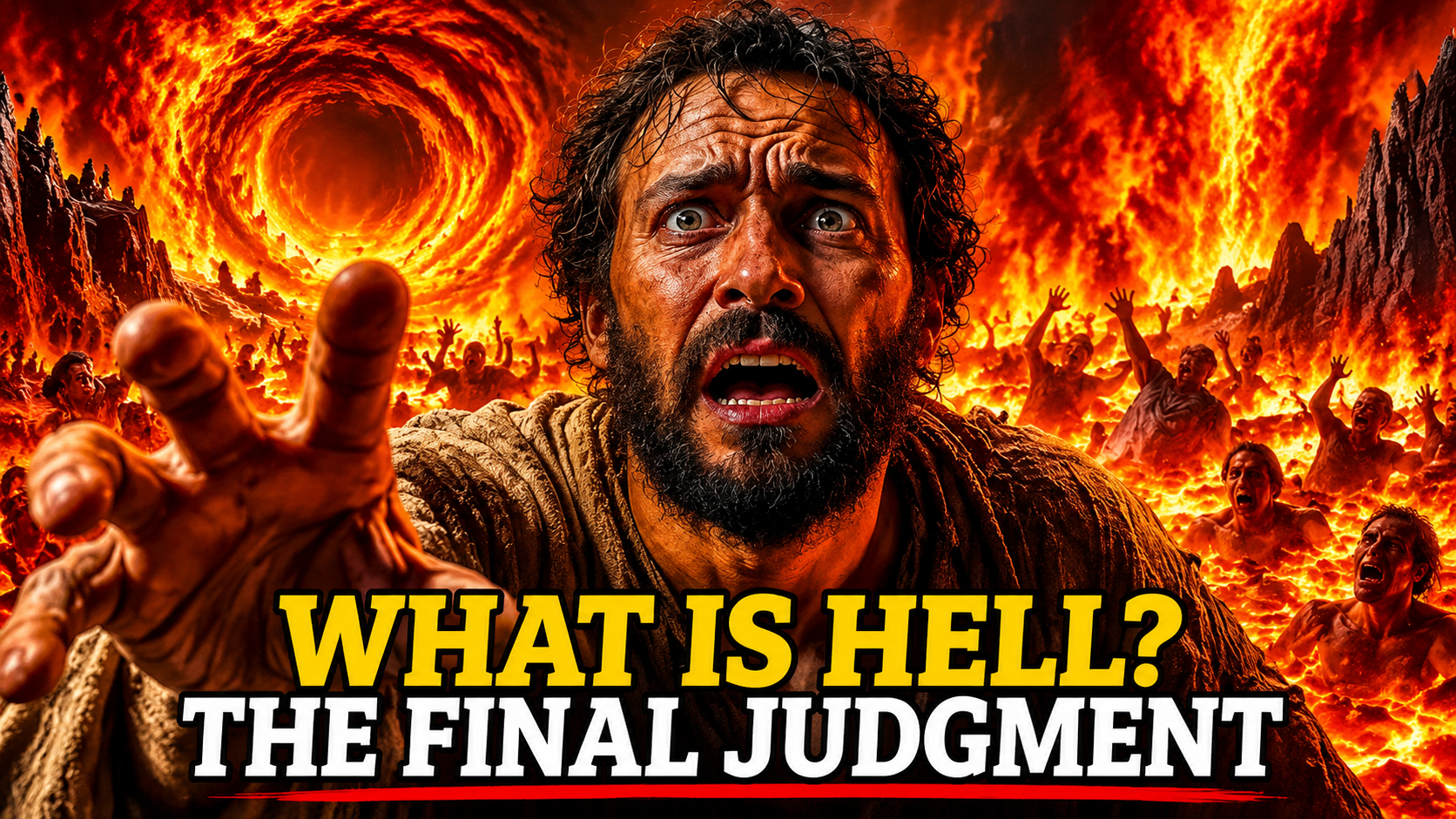
[00:54:08] Then judgment by deeds and by the Book of Life. And only then the final ends, the radiant new creation for the saved and the Lake of Fire for the rest. Hades is thrown into the Lake of Fire. The temporary is swallowed by the final. That is the architecture. The whole Bible builds toward nothing like the flat hell of popular imagination. If the Bible so carefully keeps Sheol, Hades, Gehenna and the Lake of Fire distinct, four words, four meanings across a thousand years and three languages.
[00:54:47] How did they all collapse into one English word, Hell? That story of translation, conflation and the long debate over the lost is our final chapter. We have traced four words across a thousand years.
[00:55:03] Sheol, the shadowy Hebrew grave of the Torah and the poets. Hades, the Greek name, laid over it.
[00:55:12] Gehenna, the cursed valley. Jesus made the image of final judgment and the Lake of Fire the second death revealed on Patmos.
[00:55:23] Four words, four meanings in careful sequence. Yet when most hear any of them one word, hell, flames and pitchforks.
[00:55:34] How did four become one? The answer lies in a long history of translation and a debate never settled.
[00:55:43] The flattening began in Latin when Jerome Made his great Latin Bible the Vulgate that ruled the west for a thousand years. He needed Latin words, and the language funneled several into one region.
[00:55:58] Infernus, the lower infernal place. The careful Hebrew and Greek distinctions blurred under a language with fewer compartments for the dead. The word echoed the Roman underworld. And just as Greek myth had colored Sheol before the Latin Infernus folded the terms into the Roman world below.
[00:56:21] Then the English word hell finished the work. It comes from the Norse Hel, both the underworld of northern myth and the goddess who ruled it. A realm of the dead under its own deity. Exactly. The pagan underworld Sheol had been careful not to be. When early English translators sought a native word for Sheol, Hades and Gehenna, they took this Norse name. So the king James of 1611 used one hell for all, Sheol in the old, Hades and Gehenna in the new, where the originals kept grave, intermediate, realm and valley of judgment distinct, it gave one word for all. A reader met Hel in a quiet grave psalm and in a saying about fiery judgment, unable to tell them apart. This is why modern translations have largely undone that choice.
[00:57:18] A clear difference from the old Bibles. The niv, the esv, and most recent versions no longer render Sheol as hell. They transliterate it as Sheol or translate its sense, the grave, the pit, and mark the Hebrew. In a footnote in the New Testament, they keep Hades and Gehenna apart, reserving hell for Gehenna, the word of final judgment. The effect gives readers back the distinctions. The authors made a recovery of the whole layered structure, the truth that the Bible speaks not of one hell, but of distinct realities.
[00:57:59] Beneath lies an older debate. What actually happens to the lost?
[00:58:05] From the early church, Christians divided into three answers still with us. The first, and eventually dominant, is eternal conscious torment. The lost suffer punishment that never ends. It drew on Revelation's torment forever and on sayings of Jesus, setting eternal punishment beside eternal life. Its great champion was Augustine, who argued the fire is unending and the plain sense of Scripture demands it. Through his vast influence, it became the standard teaching of the west for well over a thousand years, assumed by Dante and the medieval church.
[00:58:47] The second view is conditional immortality or annihilationism. On this reading, immortality is not automatic to all, but a gift given to the redeemed. The lost are not kept alive forever to suffer, but truly destroyed. The second death means an ending. They point to the very texts we have.
[00:59:12] God can destroy soul and body, the language of perishing and death, and the phrase from Revelation itself. The Second death. They argue that eternal torment owes more to the Greek idea of the immortal soul than than to the Hebrew scriptures. Malachi used the image of stubble in a furnace.
[00:59:33] Surely the day is coming. It will burn like a furnace. The arrogant and evildoers will be stubble, and the day will set them ablaze, leaving neither root nor branch. Stubble does not burn forever. It is consumed.
[00:59:50] That, they say, is the truer picture.
[00:59:53] A fire that destroys.
[00:59:55] The third view is the boldest and most contested universal reconciliation, the restoration of all things. On this reading, the fire is real but purifying. And in the end, God's love reclaims and restores every soul. Its famous early advocate was Origen of Alexandria, who held that punishment after death might be corrective, a severe mercy aimed at healing, so that at last, in Paul's words, God would be all in all. It has always been the minority report, and Origen's ideas were condemned by a council in the 6th century, but it never wholly vanished. Drawing on Scripture that God desires all to be saved and every knee to bow, the New Testament holds texts each camp can marshal, which is why the debate is never closed by a single verse. Consider Jude, which describes judgment in language of both chains and fire.
[01:00:58] Jude 6 and 7. The angels who abandoned their place he has kept in darkness, bound in everlasting chains for the great day. So too, Sodom and its towns, given to corruption, are an example of the punishment of eternal fire.
[01:01:16] Notice the tension packed into these two verses. The rebellious angels are held for the great day, an intermediate prison, as with Hades and Tartarus. And Sodom is an example of eternal fire, yet it no longer burns. The fire did its work. The cities are ash. So even here, eternal fire is bound to a fire whose effect, not its flames, is everlasting.
[01:01:45] One reads the words as proof of endless torment, another of final destruction.
[01:01:52] The text sustains the argument. So where does this leave us?
[01:01:57] With, at the very least, a caution and a recovery, the caution against the flat hell of the Middle Ages and a translation that fused four words into one. The Bible offers no cartoon of a fiery dungeon and a horned devil that owes more to Dante than to Scripture. What it offers is the layered story we followed.
[01:02:21] The shadowland of Sheol, where all once descended in silence, the dawning hope of resurrection that split the silence in two.
[01:02:31] The Greek Hades that named the sorted realm Gehenna, image of judgment and the lake of fire.
[01:02:40] The second death that at last abolishes the dead. And it leaves the honest fact that faithful readers long disagreed on the fate of the lost, endless torment, final destruction or ultimate restoration.
[01:02:56] Because the texts point in more than one direction. To read the Bible on hell well is to hold its distinctions and debates together, not collapse them to one word.