Episode Transcript
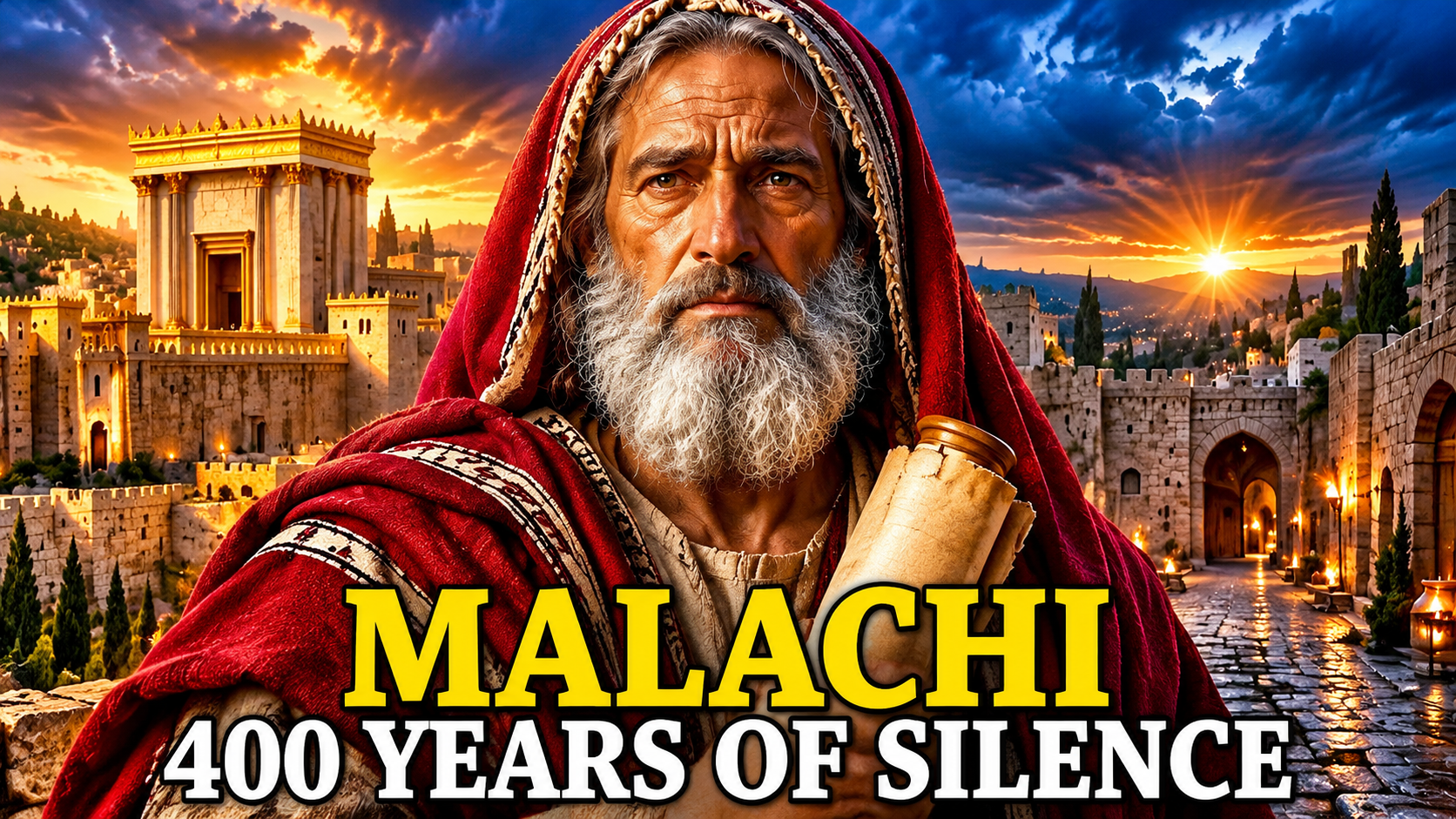
[00:00:00] The wind that came off the Judean hills in the middle of the fifth century before Christ carried dust through a city that had never quite become what it was promised to be.
[00:00:11] Jerusalem stood again, but it stood small. The wall that Nehemiah's crews had thrown up ran its uneven line around a population that historians estimate in the low thousands.
[00:00:25] A provincial town in a forgotten corner of an empire so vast that the men who ruled it in Susa and Persepolis would have struggled to find this place. On the tribute rolls, on a rise near the centre of the town, sat the temple. It was the second one.
[00:00:46] The first, Solomon's had been a thing of cedar and gold and staggering expense, and it had burned to the ground in 586 before Christ, when Nebuchadnezzar's army broke the city open.
[00:01:03] This replacement, finished around 516, was, by every honest account, a lesser building. The old men who had been children in Babylon, who had heard their grandfathers describe the first temple, looked at the second and did not always manage to hide their disappointment.
[00:01:22] That disappointment is the ground on which the last book of the Old Testament is written.
[00:01:29] To understand the prophet we call Malachi, you have to stand where his audience stood, in a settlement that had waited two generations for glory and received instead a modest sanctuary, a Persian governor and a tax bill.
[00:01:46] The people who returned from exile had come home carrying the words of earlier prophets.
[00:01:52] And those words had promised something enormous. The nations would stream to Zion, the desert would bloom, a son of David would reign.
[00:02:04] Instead, there were bad harvests, intermarriage with the surrounding peoples, a priesthood, cutting corners, and the slow grinding sense that heaven had gone quiet.
[00:02:17] The book opens with the barest possible heading. In Malachi 1, verse 1, the text announces itself. A prophecy, the word of the Lord to Israel through Malachi.
[00:02:31] That is the whole introduction. No date, no king, no genealogy of the kind that opens Isaiah or Jeremiah. Just a word delivered and a name that may not even be a name.
[00:02:46] The name is the first puzzle, and it is worth sitting with because it tells you something about the book's character.
[00:02:55] Malachi in Hebrew means my messenger.
[00:02:59] It appears nowhere else in the Hebrew Bible as a personal name.
[00:03:04] And the same word turns up a few chapters later in the third chapter, describing the messenger God will send.
[00:03:14] This has led many interpreters, ancient and modern, to wonder whether Malachi is a title rather than a birth name, a way of saying that the words come from God's messenger without telling us who the man was.
[00:03:30] The ancient Greek translation known as the Septuagint rendered the opening not as a proper name at all, but as by the hand of his messenger. Other early readers, including some in the rabbinic tradition, went further and speculated that the prophet was really Ezra, the scribe writing under a title. There is no way to settle the question, and the book does not seem to care whether we settle it. The messenger recedes so that the message can stand in front.
[00:04:02] Whoever he was, he spoke into a specific and recoverable moment, and the internal evidence pins that moment down with unusual precision. The clues are scattered through the text, and they all point the same direction.
[00:04:19] The temple is standing and functioning.
[00:04:23] So this is after 516 sacrifices are being offered, which means the altar is in daily use. There is a governor, referred to with the Persian loanword Peja, the same title used for Nehemiah, which places the book squarely inside the Persian administration of the province, the empire called Yehud. The abuses Malachi attacks, neglected tithes, mixed marriages, a careless priesthood, cheating in worship are precisely the abuses that Ezra and Nehemiah confront in their own memoirs.
[00:05:03] Most scholars therefore date the book to sometime around 460 to 430, before Christ, either just before Nehemiah's reforms or in the same generation.
[00:05:18] Malachi is very likely a contemporary of Nehemiah, addressing the same tired community from the prophetic side, while Nehemiah addressed it from the governor's residence.
[00:05:30] That makes this book the final prophetic voice of the Old Testament, not only in the order of the Christian canon, but very nearly in the order of history.
[00:05:43] After Malachi, the voice that had spoken through Moses and Samuel and Elijah and Isaiah for the better part of a thousand years fall silent.
[00:05:55] To feel the weight of that silence, you have to feel first the weight of the letdown that produced it. And here the Bible itself gives us the emotional register. A generation earlier, when the foundations of the Second Temple were being laid, the prophet Haggai had put the disappointment into words that Malachi's audience would still have carried.
[00:06:19] In Haggai 2, verse 3, the Prophet asks, who of you is left? Who saw this house in its former glory?
[00:06:28] How does it look to you now?
[00:06:31] Does it not seem to you like nothing?
[00:06:35] That question hangs over the whole world of Malachi. The people are living inside an answer that feels like nothing.
[00:06:44] The archaeology of Persian period Yehud tends to confirm the modesty of the setting rather than contradict it.
[00:06:53] Excavations across the province show a thinly settled, agriculturally stressed territory, its town small, its material culture unglamorous, a backwater loyal enough to escape imperial Attention.
[00:07:08] This was not the restored kingdom of prophecy. It was a subject province paying its dues.
[00:07:15] We are not left entirely to imagination when we try to picture the texture of Jewish life under Persia, because a remarkable cache of documents survives from the same century, though from far away, on the island of Elephantine in the Nile at the empire's southern edge, a community of Jewish soldiers in Persian service left behind a trove of papyri written in Aramaic. Those documents record their lawsuits and loans, their marriage contracts and divorces, even letters requesting permission to rebuild their own temple.
[00:07:53] They show us ordinary Jews of Malachi's era, negotiating property, quarreling over dowries, and worshipping in ways that would have troubled the reformers back in Jerusalem. The Elephantine papyri do not describe Judah directly, but they open a window onto the wider world Malachi's listeners inhabited, a world of imperial paperwork and compromised faith and the daily business of survival fair from any promised glory.
[00:08:25] It is against exactly this backdrop of loans and marriages and quiet religious drift that the prophet's specific accusations, when they come, land with their force.
[00:08:38] And they are about to come, because the striking thing about this final book is that it does not open with comfort a community this bruised, this let down, might have expected a prophet to arrive with consolation, to tell them that the glory was only delayed, that the son of David was on his way.
[00:09:02] Malachi does the opposite. He arrives as a prosecutor. The book is built as a series of arguments, disputes staged like a courtroom drama in which God makes a claim, the people object, and God answers the objection with evidence.
[00:09:21] There are six of these disputes running through the four short chapters, and together they form the last sustained speech God gives before four centuries of quiet. The very first of them cut straight to the wound. Underneath all the others, the suspicion the people had been nursing in the dark and had never quite dared to say aloud that God did not love them anymore, that the exile had been a divorce, that the modest temple and the poor harvests and the imperial taxes were the evidence of a heaven that had turned its face away.
[00:09:58] God begins there at the rawest nerve, with a claim of love that the people are ready to throw back in his face.
[00:10:07] The first argument opens with the shortest and heaviest sentence in the book.
[00:10:13] Before any charge is laid, before the priests are named or the the sacrifices inspected, God states the premise on which everything else will rest.
[00:10:25] In Malachi 1, verse 2, the exchange begins. I have loved you, says the Lord, but you ask, how have you loved us?
[00:10:36] There is the whole crisis in a single line.
[00:10:40] God asserts love.
[00:10:42] The people answer with a question mark. It is not open rebellion. Nobody in this community is bowing to foreign gods in the streets or tearing down the altar.
[00:10:55] The disease is subtler and more corrosive than idolatry.
[00:11:00] It is disbelief in the affection of God, a low, chronic doubt that had settled into the bones of a people who looked at their circumstances and could not reconcile them with the idea that they were loved.
[00:11:14] The genius and the difficulty of Malachi is that the whole book is structured around answering exactly this kind of muttered objection.
[00:11:24] God does not scold the question. He takes it seriously enough to argue.
[00:11:30] The argument he makes is one that has troubled readers for two and a half thousand years.
[00:11:37] To prove his love for Israel, God points not to Israel but to Israel's brother. The passage continues in verses 2 and 3.
[00:11:47] Was not Esau Jacob's brother? Declares the Lord. Yet I have loved Jacob, but Esau I have hated, and I have turned his hill country into a wasteland and left his inheritance to the desert jackals.
[00:12:04] The language is stark, and it is important to read it the way it's first hearers would have not as a statement about the eternal fate of two individuals, but as a statement about two nations and two histories.
[00:12:22] Jacob and Esau were the twin sons of Isaac, and from them descended two peoples, Israel from Jacob and Edom from Esau.
[00:12:32] In the Hebrew idiom of covenant, to love is to choose and bind oneself too, and to hate is to reject or pass over.
[00:12:42] God's point is national and historical.
[00:12:46] He had bound himself to the line of Jacob and had not bound himself to the line of Esau, and the proof of the difference was written across the map his listeners could see.
[00:13:00] That map is where the archaeology sharpens the text.
[00:13:04] Edom had been a real kingdom settled in the rugged highlands southeast of the Dead Sea. Its people traders and copper miners and rivals of Judah for centuries.
[00:13:16] When the Babylonians swept through the region in the 6th century, Edom suffered as Judah suffered, and in the generations that followed, something happened to it that did not happen to Judah. It did not come back.
[00:13:32] Over the Persian and early Hellenistic periods, the Edomite homeland was steadily overrun by Arab peoples pressing in from the desert.
[00:13:42] Above all, the Nabateans, the caravan traders who would eventually carve the city of Petra out of the rose coloured cliffs of what had been Edom. The Edomites who remained were pushed west into the southern hill country of Judah into a territory that came to be called Idumea. By Malachi's day, the trend was already visible, and this is precisely what the Prophet points too. Jacob's people had been carried off and brought home.
[00:14:14] Esau's people had been scattered and never restored.
[00:14:19] Look at the two histories, God says, and tell me they are the same.
[00:14:25] The desert jackals in the Edomite ruins were the evidence.
[00:14:30] Having established the premise, the prosecutor turns to the defendants. And now the tone changes from tender argument to. To open indictment.
[00:14:40] If God is a father and a master, then his household owes him something and it is not paying.
[00:14:47] In verse 6, the charge is filed. A son honours his father and a slave his master.
[00:14:55] If I am a father, where is the honour due me? If I am a master, where is the respect due me? Says the Lord Almighty.
[00:15:05] The accusation lands squarely on the priesthood, the men whose entire vocation was the honoring of God. And the specific evidence is drawn from the altar itself.
[00:15:18] The sacrificial system of Israel ran on a simple principle written into the law of Moses. What you give to God must be without defect. The best of the flock and not the worst.
[00:15:32] The book of Leviticus, in its 22nd chapter, had spelled it out in detail, forbidding the offering of any animal that was blind or injured or diseased, because a blemished gift insults the one who receives it.
[00:15:49] The priests of Malachi's day had learned to look the other way.
[00:15:54] God's rebuke on this point carries a flash of something close to sarcasm, and it is one of the most vivid moments in the book.
[00:16:02] In verse eight, he says, when you offer blind animals for sacrifice, is that not wrong? When you sacrifice lame or diseased animals, is that not wrong? Try offering them to your governor. Would he be pleased with you? Would he accept you?
[00:16:20] The thrust is impossible to miss.
[00:16:25] These same priests would never dream of bringing a sick, useless animal to the Persian governor as a tax payment or a gift, because they knew he would be insulted and they feared his displeasure. Yet they brought exactly such animals to the altar of God because they no longer feared his. The contempt was measurable.
[00:16:48] It could be seen in the quality of the livestock led up the temple steps. Behind the ritual language lies an economic reality any farmer understood.
[00:16:59] A healthy animal had market value and a blind or lame one did not.
[00:17:04] So the worshippers and the priests who indulged them were quietly keeping the good stock for themselves and passing the cows to God.
[00:17:14] The prophet's disgust reaches a pitch that would have been shocking to hear inside the temple precincts.
[00:17:22] In verse 10, God says something no priest would ever have said. Oh, that one of you would shut the temple doors so that you would not light useless Fires on my altar. I am not pleased with you.
[00:17:36] Better no worship at all, God declares, than this worship, this going through the motions with rejected animals and bored hearts.
[00:17:47] And then in a line that lifts suddenly out of the grubby present and points far beyond it, verse 11 opens a horizon the small province could barely imagine. My name will be great among the nations from where the sun rises to where it sets.
[00:18:05] In every place incense and pure offerings will be brought to me, because my name will be great among the nations, says the Lord Almighty.
[00:18:15] Here, in the middle of a rebuke about diseased sheep, is a promise that God's honour will one day fill the whole earth from east to west, in every place.
[00:18:27] The contrast is deliberate and crushing.
[00:18:30] The people God had chosen were dishonouring him at his own altar, while a day was coming when strangers across the world would honour him better than his own priests did. Now the section ends in verse 14 with a curse laid on deliberate fraud. Cursed is the cheat who has an acceptable male in his flock and vows to give it, but then sacrifices a blemished animal to the Lord from the defective offerings. God turns directly to the men who accepted them. And the second chapter opens with the priesthood squarely in the dock.
[00:19:10] The threat is severe and pointed at the very thing a priest existed to pronounce.
[00:19:18] In the second verse of chapter two, God warns that if they will not listen and honour his name, I will send a curse on you, and I will curse your blessings.
[00:19:31] The men whose office was to bless the people would find their blessings and turned to curses at the root. What makes the indictment sting is the memory of what the priesthood was supposed to be, and Malachi does not let that memory fade. In verse 7 he states the ideal in words that define the whole vocation.
[00:19:54] For the lips of a priest ought to preserve knowledge, and from his mouth men should seek instruction, because he is the messenger of the Lord Almighty.
[00:20:07] The priest was meant to be a living channel between heaven and the people, a keeper of the law, a teacher whose mouth could be trusted.
[00:20:17] That word messenger is the same word that gives the book its name and its appearance. Here is no accident.
[00:20:26] The priests were supposed to be God's messengers, and they had failed at the one thing the title required.
[00:20:34] Instead, verses 8 and 9 deliver the verdict. They had turned from the way, caused many to stumble by their teaching, and violated the covenant with Levi. And so God had made them despised and humiliated before all the people because they showed partiality in matters of the law.
[00:20:56] Having tried the priests at the altar, the prophet widens the frame to take in the whole community, and he does it by appealing to something that should have bound them together and instead had come apart. In Malachi 2 10, the argument turns do we not all have one father?
[00:21:17] Did not one God create us? Why do we profane the covenant of our ancestors by being unfaithful to one another?
[00:21:26] The logic moves from the vertical to the horizontal in a single breath because they share one father and one maker. The people of Judah are brothers, and treachery against a brother is treachery against the covenant itself. The word that keeps recurring in this section is faithlessness, the Hebrew idea of acting treacherously, dealing falsely with someone who had a right to trust you.
[00:21:56] It is the language of a broken marriage, and Malachi uses it in two directions at once, because the community's unfaithfulness to God and its unfaithfulness within its own homes had become the same disease Wearing two faces the first face is intermarriage, and to understand why the prophet treats it as a crisis rather than a private matter, you have to remember how fragile this community actually was.
[00:22:28] A few thousand people clustered in a small province surrounded by larger populations who worshipped other gods had come home from exile precisely because they had held on to a distinct identity through two generations. In Babylon that identity was now dissolving at the edges through marriage.
[00:22:51] In verse 11 the charge is blunt. Judah has been unfaithful.
[00:22:57] A detestable thing has been committed in Israel and in Jerusalem. Judah has desecrated the sanctuary the Lord loves by marrying women who worship a foreign God.
[00:23:11] The concern here is not ethnic in the modern sense it is religious survival.
[00:23:17] The men of Judah were marrying into families that served other deities, and everyone understood how households actually worked. In the ancient world, the religion of the home was largely the mothers to shape, and children raised by a mother who worshipped a foreign God would drift toward that God within a generation or two. The distinct faith of Israel carried home at such cost could simply be married out of existence. This is not an isolated complaint, and its historical anchor is firm because the same crisis is documented in detail by two men who lived in the same generation as Malachi and left behind their own accounts. Ezra the scribe, arriving in Jerusalem with a commission from the Persian court, was reportedly appalled to discover how widespread the intermarriage had become, and the ninth and tenth chapters of the book that bears his name describe his public grief and the drastic, painful reforms that followed.
[00:24:26] Nehemiah the governor confronts the same problem near the end of his memoir in the 13th chapter, where he describes finding children who could no longer even speak the language of Judah because their mothers came from Ashdod and Ammon and Moab.
[00:24:44] Malachi stands beside these two figures as the prophetic voice denouncing exactly what the scribe and the governor were legislating against three witnesses.
[00:24:56] One crisis. The convergence is part of what lets historians date the book so confidently to the middle of the fifth century. And it shows the prophet was not attacking a hypothetical sin, but a live emergency in the streets around him. Woven into the same passage is the second face of the treachery, and it is here that Malachi's words have echoed longest and cut deepest.
[00:25:23] The men who were marrying foreign wives were in many cases divorcing the wives they already had to do it.
[00:25:31] The prophet turns to defend those discarded women with a tenderness rare in prophetic literature. In verse 14, he answers the objection of men who could not understand why their worship was being rejected. You ask why?
[00:25:48] It is because the Lord is the witness between you and the wife of your youth. You have been unfaithful to her, though she is your partner, the wife of your marriage covenant.
[00:26:01] The phrase the wife of your youth carries the whole weight of a shared life, a woman married in the years of poverty and beginnings now set aside when a more advantageous match appeared. God, Malachi insists, had stood as a witness at that marriage, which makes the betrayal not merely a domestic failure, but a violation of a covenant to which heaven was a party.
[00:26:29] The prophet presses the point to its climax with a warning repeated like a refrain in verse 15. He urges, so be on your guard and do not be unfaithful to the wife of your youth. And then in verse 16 comes the line that has anchored discussions of marriage and divorce ever since. The man who hates and divorces his wife says the Lord, the God of Israel does violence to the one hege should protect, says the Lord Almighty. So be on your guard and do not be unfaithful. The Hebrew of this verse is famously difficult, and different translations have rendered it in different ways over the centuries. But the moral center holds steady across all of them.
[00:27:19] Divorce in this context is is described as an act of violence, a covering of one's garment with wrong, a betrayal of someone the man was bound to shelter. It is worth noting how radical this defense of vulnerable women was in its own world.
[00:27:38] In the legal culture of the ancient Near East, a wife discarded by her husband had few protections and an uncertain future, often thrown back on relatives or reduced to destitution.
[00:27:53] The Aramaic marriage and divorce contracts from the Jewish community at Elephantine spell out in dry legal language exactly how a marriage could be dissolved and what a woman was or was not owed when it ended, showing us the very machinery of the transactions Malachi condemns.
[00:28:15] The chapter closes by circling back to the theme that opened the book, the suspicion festering underneath all the specific sins, and Malachi captures it in a phrase that has become one of the most quietly devastating lines in the Old Testament.
[00:28:34] The people had grown cynical, and that cynicism had begun to slander God directly.
[00:28:41] In verse 17, the Prophet says, you have wearied the Lord with your words.
[00:28:48] How have we wearied him, you ask?
[00:28:52] By saying, all who do evil are good in the eyes of the Lord, and he is pleased with them. Or where is the God of justice?
[00:29:03] That last question is the sound of a faith curdling into despair. Look around, the people were saying, the wicked prosper, the unfaithful get their advantageous marriages and their good harvests.
[00:29:18] The line between good and evil seems to make no difference to how life turns out. So either God cannot tell the difference or he does not care.
[00:29:28] Where is the God of justice? It is the oldest complaint in the religious life, and Malachi's audience had made it into a shrug, a way of excusing their own compromise by accusing Heaven of indifference.
[00:29:45] The answer to that lazy, corrosive question arrives with a jolt.
[00:29:50] The people had asked where the God of justice was, and the third chapter opens with God telling them, in effect, to be careful what they wished for. In Malachi 3 1, the reply comes, I will send my messenger who will prepare the way before me. Then suddenly the Lord you are seeking will come to his temple.
[00:30:13] The messenger of the covenant whom you desire will come, says the Lord Almighty.
[00:30:20] The word suddenly is the hinge of the whole verse. This is not a distant, comfortable promise of eventual reckoning.
[00:30:29] It is a warning that the God they had grown careless about was going to arrive at his own temple without warning, walking into the very sanctuary where they had been offering their blind animals and going through their empty motions.
[00:30:46] And before him would come a herald, a messenger sent to prepare the road the way a servant runs ahead of a king to make the path straight.
[00:30:56] That figure, the forerunner, would become one of the most important sentences in the Old Testament for the way the New Testament would later read it. But in its own moment it functioned as a threat as much as a hope. The Master was coming home unannounced to inspect the house.
[00:31:16] The people had assumed that the day of the Lord, when it finally came, would be a day of vindication for them and judgment for their enemies. Malachi shatters that assumption.
[00:31:29] The judgment, he warns, would begin at home, and it would begin with the very people asking for it.
[00:31:38] In verse 2, the prophet turns the longed for day into something terrifying. But who can endure the day of his coming?
[00:31:47] Who can stand when he appears?
[00:31:49] For he will be like a refiner's fire or a launderer's soap.
[00:31:55] Both images are images of violent cleaning.
[00:31:59] The launderer's soap was a harsh, alkaline substance made from plant ashes that was pounded and scrubbed into cloth to beat the filth out of it. The refiner's fire was fiercer still, and the metaphor repays a close look, because Malachi's audience understood the process in a way modern readers often do not.
[00:32:23] To refine silver in the ancient world, a smith used a technique the archaeologists call cupellation.
[00:32:31] The ore was heated in a shallow, porous vessel, too, an extreme temperature, until the metal turned molten and the impurities, the dross, rose to the surface or were absorbed away, leaving the pure silver behind.
[00:32:47] It was slow, hot, exacting work, and the refiner had to watch the metal constantly because too little heat left the impurities in and too much destroyed the silver itself.
[00:33:01] That is the picture God draws of what his coming will do to his own priesthood.
[00:33:09] In verse three, the prophet continues, he will sit as a refiner and purifier of silver. He will purify the Levites and refine them like gold and silver. Then the Lord will have men who will bring offerings in righteousness.
[00:33:27] Notice that the fire is aimed first not at Israel's enemies, but at the sons of Levi, the same priests whose corruption filled the first two chapters. The point of the fire is not destruction but purification.
[00:33:45] God intends to sit down at the crucible like a patient smith and burn the corruption out of the priesthood until what is left is pure enough to serve him properly, until there are once again men who bring offerings the way the offerings were meant to be brought.
[00:34:03] There is mercy hidden inside the severity.
[00:34:06] The refiner does not throw the silver away, he reclaims it. But the reclaiming hurts, and the people who had been demanding that God act had not reckoned on being the metal in the fire.
[00:34:20] The purifying fire then broadens from the priests to the whole society, and here God names the sins that had made the community rot from within.
[00:34:31] In verse 5, he promises to draw near for judgment and to testify swiftly against the sorcerers and adulterers and perjurers, against those who defraud laborers of their wages, who oppress the widow and the fatherless, and who deprive the foreigner among them of justice. It is a catalogue of the ways the strong were preying on the weak, and it lands on precisely the people the law had always commanded Israel to protect.
[00:35:02] The worker owed his pay, the widow with no husband to defend her, the orphan with no father, the foreigner with no clan. A society is measured, Malachi implies, by how it treats the people who cannot fight back.
[00:35:18] And this society was failing the measurement. The God of justice they had cynically summoned would indeed come, and he would come as a witness against them. And yet the chapter refuses to collapse into pure threat, because underneath the warning runs a current of astonishing steadiness.
[00:35:38] The reason this exhausted, compromised people had not simply been wiped away is that God does not abandon what he has bound himself to.
[00:35:49] In verse six comes one of the great anchoring lines of the book. I, the Lord, do not change, so you, the descendants of Jacob, are not destroyed.
[00:36:02] Their survival was not a reward for their faithfulness, which was threadbare, but a consequence of God's own constancy.
[00:36:11] He had chosen the line of Jacob, and he does not change his mind.
[00:36:17] That unchanging character is is what makes the next words an invitation rather than a dismissal.
[00:36:25] In verse seven, God calls out across the distance, the people had opened up. Return to me and I will return to you, says the Lord Almighty.
[00:36:36] And true to the pattern of the whole book, the people answer the invitation with an evasion. But you ask, how are we to return?
[00:36:46] As if they did not know, as if the road back were a mystery.
[00:36:51] God's reply is concrete and almost startlingly practical. He tells them that the way back to him runs, of all places, through their wallets.
[00:37:02] The evasion is met with an accusation that must have stunned the room.
[00:37:08] In verse eight, God says, will a mere mortal rob God? Yet you rob me.
[00:37:14] But you ask, how are we robbing you in tithes and offerings.
[00:37:21] The community had been withholding the tithes that were supposed to support the temple and its ministers, keeping for themselves what belonged to God. And Malachi names it with a scandalous word, robbery.
[00:37:36] This was not an abstract failing. The economy of the second temple depended on those contributions.
[00:37:44] The storehouses attached to the temple were meant to hold the grain and produce that fed the Levites and the temple staff.
[00:37:53] And Nehemiah's memoir describes the practical collapse of exactly this system.
[00:37:59] The chambers standing empty, the Levites forced to abandon there posts and return to their fields because the people had stopped bringing what they owed. When the tithes dried up, the whole apparatus of worship ground toward a halt.
[00:38:16] To rob the storehouse was to starve the house of God.
[00:38:22] Then comes the single most famous line in the book, and the only place in all of Scripture where God explicitly invites his people to put him to the test.
[00:38:34] In verse 10, the challenge is laid down. Bring the whole tithe into the storehouse that there may be food in my house.
[00:38:44] Test me in this, says the Lord Almighty, and see if I will not throw open the floodgates of heaven and pour out so much blessing that there will not be room enough to store it.
[00:38:57] The image is agricultural and generous to the point of extravagance. The windows of heaven flung open the rain of blessing so heavy that the barns cannot contain the harvest it produces. To a farming community living hand to mouth on stony soil under a heavy tax burden, this was a promise aimed directly at their deepest anxiety.
[00:39:24] Give first, God says, and watch what I do. The return to God that the people had claimed not to understand turned out to begin with a wagon of grain brought up to the temple in trust rather than kept back in fear.
[00:39:40] Before the book turns its eyes to the horizon, it records one last exchange, and it is the bitterest of them all.
[00:39:49] The people's cynicism, which had started as a muttered question about God's love, had hardened into open contempt. In Malachi 3:13, God confronts it directly.
[00:40:02] You have spoken arrogantly against me, says the Lord, yet you ask, what have we said against you?
[00:40:10] And then, in the verses that follow, the prophet quotes back to them the words they had been saying, and they are the words of a faith gone completely cold.
[00:40:22] They had said it was futile to serve God, that there was no profit in keeping his requirements or walking about like mourners in repentance before him.
[00:40:34] Worse, they had begun to envy exactly the people they should have pitied. They called the arrogant blessed. They said that evildoers prosper and that those who challenge God to his face get away with it. This is the end point of the road the whole book has been tracing. A people who no longer believe God loves them will in the end come to believe that serving him is a waste and that the wicked have chosen the smarter path.
[00:41:05] It is despair dressed up as realism, and it had spread through the community like a stain.
[00:41:13] But at the darkest moment of the book, something quietly turns, and it turns around a small group who had not given in.
[00:41:22] Not everyone had grown cynical.
[00:41:25] In verse 16, the camera pulls back to show them.
[00:41:29] Then those who feared the Lord talked with each other. And the Lord listened and heard.
[00:41:37] A scroll of remembrance was written in his presence concerning those who feared the Lord and honoured his name.
[00:41:45] Here is one of the most tender images in all the prophets.
[00:41:50] While the crowd complained that serving God was pointless, a remnant of the faithful were speaking to one another, encouraging each other to hold on. And heaven was leaning in to listen.
[00:42:04] And God did something with what he heard. He had it written down, a scroll of remembrance, a book kept in the presence of God, recording the names of those who feared him, when fearing him had gone out of fashion. The ancient Persian court kept exactly such books, royal chronicles in which loyal deeds were recorded so the king could reward them later, and the image would have been immediately legible to a people living under that empire.
[00:42:36] Their faithfulness was not being lost in the noise. It was being entered into the permanent record of the king.
[00:42:44] That record exists for a day, and the day is coming.
[00:42:49] In verse 17, God speaks of on the day when I act, says the Lord Almighty, they will be my treasured possession. I will spare them, just as a father has compassion and spares his son who serves him.
[00:43:06] The cynics had said there was no difference between serving God and not serving him. God answers that a day is coming when the difference will be the only thing that matters. Verse 18 drives it home.
[00:43:21] On that day the people will again see the distinction between the righteous and the wicked, between those who serve God and and those who do not.
[00:43:31] The line the people thought had been erased was going to be redrawn in fire, and everyone would see which side of it they stood on.
[00:43:41] The final chapter opens with that fire.
[00:43:45] In Malachi 4 1, the day arrives in full.
[00:43:50] Surely the day is coming. It will burn like a furnace.
[00:43:55] All the arrogant and every evildoer will be stubble. And the day that is coming will set them on fire, says the Lord Almighty. Not a root or a branch will be left to them.
[00:44:09] It is a harvest image turned to judgment. After the grain is gathered, the dry stubble left standing in the field is burned off.
[00:44:18] And the arrogant who had called themselves blessed would be that stubble consumed root and branch.
[00:44:27] But the same sunrise that scorches the stubble warms the faithful, and the very next verse turns the fire into light.
[00:44:36] In verse two, God promises, but for you who revere my name, the sun of righteousness will rise with healing in its rays, and you will go out and frolic like well fed calves.
[00:44:49] The image is of dawn breaking over a long night, a healing warmth spreading across the horizon, and the faithful running out into it like young cattle. Released from the stall into the morning pasture.
[00:45:03] The same day is furnace and sunrise, terror and healing, depending entirely on where a person stands.
[00:45:13] Then, as the book prepares to close, it does two things that function almost like a signature on the entire Old Testament.
[00:45:24] First, in verse four, it looks backward. Remember the law of my servant Moses, the decrees and laws I gave him at Horeb for all Israel. At the very end of the prophetic era, the last prophet points back to the first great mediator, Moses, and to the law given at Horeb, which is Sinai.
[00:45:48] It is as if the whole tradition, from the mountain of the law to the final prophet, is being gathered up and handed to the people with a single instruction.
[00:46:00] Hold on to what you were given. Remember. And then, in verses five and six, the book looks forward, and it does so with a prophecy that would hang over the next four centuries like a held breath.
[00:46:14] See, I will send the prophet Elijah to you before that great and dreadful day of the Lord comes.
[00:46:23] He will turn the hearts of the parents to their children and the hearts of the children to their parents, or else I will come and strike the land with total destruction.
[00:46:36] Elijah, the prophet who had confronted kings and called down fire and been carried into heaven in a whirlwind of flame centuries before, would come again before the great and dreadful day. It is the last promise the Old Testament makes, and it points beyond itself.
[00:46:57] Some coming figure, an Elijah, would arrive to prepare the people, to heal the fractures between generations, to ready the nation for God's own arrival.
[00:47:08] And with that promise of a forerunner still ringing, the voice of prophecy stops.
[00:47:15] This is where the timing matters, because these are quite literally the last recorded words that God speaks to Israel through a prophet. For the next 400 years after Malachi, the sky goes quiet.
[00:47:31] There is a subtle problem with ending a sacred book on the word destruction.
[00:47:37] And the way different traditions handled it tells you something about how the book was read. In the Christian ordering of the Old Testament, Malachi stands last.
[00:47:48] So the entire first half of the Bible ends on that dark note of a threatened curse deliberately left hanging so that the promise of Elijah pulls thee reader forward toward what comes next.
[00:48:03] In the Hebrew ordering of the scriptures, the Tanakh, the books are arranged differently, and the collection ends not with Malachi, but with Chronicles closing on a note of return and rebuilding.
[00:48:18] And in the synagogue, when Malachi is read aloud, an old custom has the reader go back and repeat the gentler verse about Elijah turning hearts rather than let the public reading end on the word of destruction.
[00:48:33] Across all these traditions, there is the Same instinct at work.
[00:48:38] The last word of the prophets is heavy, and it aches for a resolution the book itself does not provide.
[00:48:46] That resolution would not come for a very long time.
[00:48:50] The Jewish writers who lived in the centuries after Malachi were acutely aware that something had ended.
[00:48:58] The books of the Maccabees, written during the turbulent times that followed, speak plainly of the absence of prophets in the land of decisions that had to be postponed until a trustworthy prophet should arise.
[00:49:13] Of a time when prophets had ceased to appear among them, they knew they were living in the silence.
[00:49:21] The voice that had spoken through Moses at Horeb and through Elijah on Carmel, and through Isaiah and Jeremiah, and now, last of all, through the messenger called Malachi, had fallen still. And it left behind a single unfulfilled promise, a forerunner who had not yet come, and a day that had not yet dawned.
[00:49:46] The phrase the 400 years of silence is one of those pieces of religious shorthand that can mislead as much as it illuminates.
[00:49:56] So it is worth saying clearly what did and did not fall silent.
[00:50:02] What ended with Malachi was the succession of canonical prophets, the line of men and women through whom the tradition held God spoke directly and authoritatively to Israel.
[00:50:17] No new book would be added to the Hebrew Scriptures across this span.
[00:50:22] No voice would stand in the gate of Jerusalem and say, thus says the Lord, with the recognized authority of an Isaiah or a Jeremiah. That is the silence.
[00:50:35] It is a silence of revelation, not a silence of history. And the distinction matters enormously, because the four centuries that followed Malachi were among the loudest and most violent and most transformative in the entire experience of the Jewish people.
[00:50:54] Empires rose and fell over their heads.
[00:50:58] Their temple was defiled and reclaimed, their language shifted, their literature exploded, and the religious parties that would populate the Gospels were all born in this period.
[00:51:11] God may have stopped sending prophets, but the world did not stop turning. And by the time the silence broke, the Jewish world had been remade almost beyond recognition.
[00:51:24] The silence began quietly under the same Persian rule that had framed Malachi's whole message for roughly the first century of the Aetius period, from the late fifth century into the fourth Judea, remained a small temple state within the Persian empire, governed by its high priests under the oversight of imperial officials, paying its tribute, keeping its law, drawing little attention.
[00:51:55] These were years that left few records precisely because they were stable.
[00:52:01] The province of Yehud minted its own small coins, maintained its temple, and lived the unremarkable life of a loyal imperial backwater.
[00:52:13] The great drama of the age was happening elsewhere in the long grinding rivalry between Persia and the Greek city states across the Aegean. A rivalry that had produced the famous wars a Greek would remember at Marathon and Thermopylae and Salamis.
[00:52:32] And that was slowly, decade by decade, shifting the balance of the world westward. Judea sat on the sidelines of that struggle, unaware that its outcome would reshape everything.
[00:52:46] The change, when it came, came with the speed of a cavalry charge and the force of an earthquake.
[00:52:55] In the year 336 BC, a 20 year old inherited the throne of Macedon, a rough kingdom on the northern edge of the Greek world. And within a decade he had done something new one had imagined possible.
[00:53:12] Alexander, whom later ages would call the Great, led his armies east against the Persian empire and did not stop until he had conquered the whole of it, from the Aegean to the borders of India.
[00:53:27] In 333, he shattered the main Persian army at Issus, in what is now southern Turkey. And then he turned down the coast of the Mediterranean, taking the great cities of the Levant one after another.
[00:53:44] In 332, his march brought him through the land of Judea itself, on his way to the conquest of Egypt.
[00:53:53] In the span of a very few years, the empire that had ruled the Jews since the days of Cyrus simply ceased to exist.
[00:54:03] And a Greek speaking Macedonian became master of their world.
[00:54:08] There is a famous story about Alexander and Jerusalem preserved by the Jewish historian Josephus in the 11th book of his great work on Jewish antiquities, written more than three centuries later.
[00:54:23] According to Josephus, as Alexander approached Jerusalem, the highest priest went out to meet him in his priestly robes. And Alexander, rather than sacking the city, bowed before the priest and treated the temple with honour, explaining that he had seen this very figure in a dream that had promised him victory over Persia.
[00:54:47] Josephus even claims that Alexander was shown the Book of Daniel and recognized in its prophecies and a prediction of his own conquests.
[00:54:58] Historians treat the tale with heavy skepticism. It has the shape of a legend crafted to give the Jews a dignified place in the story of the world conqueror, and no Greek source records it.
[00:55:14] But whether or not Alexander ever stood before the Temple, the underlying reality the story dramatizes is entirely true.
[00:55:24] Judea passed into Greek hands without being destroyed, and the encounter between the faith of Israel and the culture of Greece had begun. That encounter is the deep event of the whole period, far more important than any battle. And it has a name, Hellenism.
[00:55:43] Alexander did not merely conquer territory. He carried with him and deliberately planted an entire civilization.
[00:55:53] Wherever his armies went, Greek cities were founded or refounded. Greek became the language of administration and commerce. Greek gymnasiums and theatres and marketplaces appeared, and with them came a whole way of seeing the world.
[00:56:11] Confident, cosmopolitan, humanistic, and utterly foreign to the covenant faith of Judea.
[00:56:19] The Greek language became the common tongue of the Eastern Mediterranean, the way English functions across much of the world today.
[00:56:28] So that a Jew in Alexandria or Antioch might live his whole life speaking and thinking in Greek.
[00:56:36] This was the cultural earthquake Malachite descendants had to survive. And it posed a question sharper than any the Persians had ever posed.
[00:56:47] Persia had demanded tribute and loyalty.
[00:56:50] Greece demanded something more intimate and more dangerous. It invited the Jews to become like everyone else, to translate their strange, exclusive, unfashionable faith into the reasonable idiom of the wider world.
[00:57:06] And in doing so, perhaps to dissolve it.
[00:57:10] The pull of that invitation can be measured in a single enormous fact.
[00:57:15] It was in this period that a large and permanent Jewish community grew up in Egypt, centered on the new city that bore the conqueror's own name.
[00:57:27] Alexander had founded Alexandria on the Egyptian coast in 331, and it swiftly became one of the greatest cities of the ancient world, a centre of trade and learning with its famous library and home to a Jewish population that would eventually number in the hundreds of thousands. These were Jews who lived their entire lives in Greek.
[00:57:51] Within a few generations, many of them could no longer read the Hebrew scriptures of their ancestors. And this simple linguistic fact would soon force one of the most consequential religious projects in history.
[00:58:07] The translation of of the Hebrew Bible into Greek. For now, it is enough to see that the Jewish world was no longer confined to the hills of Judea. It had spread across the Mediterranean and it was learning to think in the language of Athens. There is one more thread worth drawing out of this period, because it shaped how the Jews themselves understood what was happening to them. The Greek God conquest did not catch the biblical tradition entirely unprepared. The Book of Daniel, set in the earlier days of the Babylonian and Persian courts, contains visions of successive world empires rising and falling. And among them a vision in its eighth chapter of a swift and powerful goat from the west that charges across the earth without touching the ground and shatters a great ram only for its own single great horn to be broken at the height of its power and replaced by four lesser horns. Readers in the Hellenistic age saw in that vision an unmistakable portrait of their own moment. The goat from the west as the Greek kingdom, its great horn as Alexander himself and the four horns that replaced it as what happened next.
[00:59:30] Because the truly fateful thing about Alexander for the Jews was not his conquest, but his death.
[00:59:38] He died in Babylon in 323 before Christ, still only in his early 30s with no capable heir. And the empire he had welded together in a decade came apart almost at once.
[00:59:52] His generals, the men history calls the successors, fell to fighting over the carcass of his empire. And after 40 years of war, the pieces settled into a handful of rival Greek kingdoms, each ruled by a dynasty descended from one of those generals.
[01:00:11] Two of those kingdoms mattered above all others for the Jews because Judea lay directly between them on the fault line where they ground against each other. To the south in Egypt ruled the house of Ptolemy.
[01:00:26] To the north in Syria and the vast eastern lands ruled the house of Seleucus.
[01:00:34] For the next century and a half, the small province of Judea would be caught in the middle, passed back and forth between these two groups, Greek powers like a contested borderland. And the pressure of that position would eventually produce the greatest crisis of the entire silent age. For about a century after Alexander's death, Judea belonged to the southern kingdom, the Ptolemies of Egypt. And these were on the whole, tolerable years.
[01:01:06] The Ptolemies ruled from Alexandria with a light hand over Judean religious life, content to collect taxes through the high priest and leave the temple alone. It was under Ptolemaic rule and largely for the sake of that vast Greek speaking Jewish community in Alexandria, that the single most important literary project of the whole silent age was carried out. The translation of the Hebrew scriptures into Greek.
[01:01:37] This translation is known as the Septuagint, from the Latin word for 70 because of a legend about its origins preserved in an ancient document called the Letter of Aristeas.
[01:01:51] According to that letter, the Egyptian king Ptolemy ii, wanting a copy of the Jewish law for his great library, sent to Jerusalem for scholars and 72 elders.
[01:02:04] Six from each of the 12 tribes came to Egypt and produced the translation.
[01:02:10] The details of the legend are almost certainly embroidered, but the core is history.
[01:02:16] Beginning in the third century before Christ, the Torah and then the rest of the Hebrew scriptures were rendered into Greek and the effects were incalculable.
[01:02:28] For the first time, the scriptures of Israel could be read by anyone in the ancient world who read Greek, which meant nearly everyone educated.
[01:02:39] The Septuagint would become the Bible of the early diaspora and later the version most often quoted by the writers of the New Testament.
[01:02:50] The tolerable century ended when Judea changed hands around the year 200. Before Christ.
[01:02:59] After a long series of wars between the two Greek dynasties, the northern kingdom finally wrested control of the province away from Egypt.
[01:03:09] Judea now belonged to the Seleucids, the house that ruled from Syria over the sprawling eastern remains of Alexander's empire. And the change of masters would prove catastrophic.
[01:03:24] For a generation, it made little difference. But in 175 BC, a new king came to the Seleucid throne, and his reign became the great trauma around which the entire silent age turns.
[01:03:39] His name was Antiochus iv, and he took for himself the title Epiphanes, meaning God Manifest, a claim to divinity that captures the whole character of the man. Contemporaries who despised him twisted the title into Epimenes the Madman.
[01:04:00] Antiochus came to power over a kingdom under severe financial and military pressure, squeezed by the rising power of Rome to the west. And he conceived an ambition to weld his diverse territories together through a shared Greek culture.
[01:04:18] In most of his realm, this program of Hellenization met little resistance in Jerusalem. It collided with the one people in the ancient world who could not simply absorb another God into their pantheon because they held that there was only one. The crisis did not begin entirely as foreign persecution. It began partly as a civil war within Judaism itself between Jews who embraced Greek culture and wanted Jerusalem remade as a Greek city, and Jews who regarded that as the death of the covenant. Hellenizing priests bought the high priesthood from Antiochus with bribes, built a Greek gymnasium in the shadow of the temple, where young men exercised naked in the Greek fashion, and set about dismantling the ancestral lore from the inside.
[01:05:14] When rival factions among these priests fell to fighting and a rumour spread that Antiochus had died on campaign in Egypt, Jerusalem erupted and the king returned in fury to punish what he took for rebellion.
[01:05:31] What followed was the first systematic attempt in history to destroy the Jewish religion outright. In 167, before Christ, Antiochus issued decrees that made the practice of Judaism a capital crime. Sabbath observance was banned. Circumcision was forbidden on pain of death.
[01:05:52] Copies of the Torah were burned and mothers who circumcised their sons were executed with their infants hung around their necks. Then he struck at the heart of everything.
[01:06:05] He entered the temple in Jerusalem, plundered its treasures, halted the daily sacrifices, and In December of 167, he rededicated the temple of the God of Israel to the Greek God Zeus, erecting an altar to Zeus upon the sacred altar and according to the ancient accounts, sacrificing swine upon it.
[01:06:30] This desecration is the event that the book of Daniel in its visions calls the abomination that causes desolation.
[01:06:39] And readers of Daniel in this period saw its 11th chapter, with its extraordinarily detailed account of wars between a king of the north and a king of the south, as a prophetic map of exactly the Seleucid and Ptolemaic struggle that had brought them to this catastrophe. The holy place had been made an altar to a foreign God, and the faith of Israel stood on the edge of extinction. It did not go over the edge because of a family.
[01:07:09] In the village of Modane, northwest of Jerusalem, an aging priest named Mattathias refused the king's officers when they came to enforce pagan sacrifice, killed the first Jew who stepped forward to comply along with the royal official, and fled to the hills with his sons to raise a revolt.
[01:07:32] When Mattathias died, leadership passed to his son Judas, who bore the nickname Maccabeus, probably meaning the hammer. And it is from him that the whole struggle takes its name, the Maccabean Revolt.
[01:07:48] What Judas and his brothers accomplished over the next several years was, by any military standard, remarkable.
[01:07:56] Leading a guerrilla army of farmers and villagers against the professional forces of a Greek empire.
[01:08:04] Exploiting the mountainous terrain and the divided attention of a Seleucid state distracted by threats elsewhere, they won a series of improbable victories.
[01:08:16] And In December of 164, before Christ, three years to the season after the desecration, Judas retook the temple, tore down the defiled altar, built a new one, and rededicated the sanctuary to the God of Israel.
[01:08:34] That rededication is the origin of the festival the Jews still keep as Hanukkah, the feast of dedication, a celebration of light returning to a temple that had been given over to darkness.
[01:08:48] The revolt's success opened a new and complicated chapter, because the family that had saved the faith went on to rule. The descendants of Mattathias, known as the Hasmonean dynasty, gradually won not just religious freedom, but full political independence as the Seleucid empire crumbled around them.
[01:09:12] For the first time since the Babylonians had ended the kingdom Mer athea, Judah, more than four centuries earlier, the Jews governed themselves, an independent Jewish state ruled by the Hasmoneans, who combined in their own persons the offices of high priest and eventually king.
[01:09:35] Yet the independence came trailing its own ironies.
[01:09:40] Within a few generations, the Hasmoneans, who had risen up against Greek culture, had themselves become a worldly dynasty, adopting Greek customs and Greek names, expanding their borders by conquest and forcing conversions on the peoples they subdued and tearing themselves apart in dynastic feuds.
[01:10:03] The house that had cleansed the Temple came to be seen by many devout Jews as one more compromised power.
[01:10:11] It is out of exactly these pressures, the trauma of persecution and the disappointments of Hasmonean rule, that the religious landscape of the Gospels took shape. The parties whose names fill the New Testament were all products of this age.
[01:10:28] The Pharisees emerged as a movement devoted to applying the whole law of Moses to everyday life, developing the traditions that would later feed Rabbinic Judaism.
[01:10:42] The Sadducees, drawn from the priestly and aristocratic families tied to the Temple, held to the written law alone and made their peace with the ruling powers.
[01:10:54] And a third movement, convinced that both the priesthood and the nation had been hopelessly corrupted, withdrew from Jerusalem altogether.
[01:11:05] Many scholars connect this impulse with the community that settled at Qumran by the Dead Sea, the community that produced or preserved the library we now call the Dead Sea Scrolls.
[01:11:18] Discovered in the caves above the shoreline in the 20th century.
[01:11:23] Those scrolls, copied and composed during these very centuries in, include the oldest surviving manuscripts of the Hebrew Bible by a margin of a thousand years.
[01:11:34] And they are the single greatest archaeological window we possess into the Jewish world of the silence, a world seething with expectation, convinced it was living in the last days, watching for God to act. And even as the Hasmonean state quarreled with itself, a new and heavier power was moving down from the west, one that would end Jewish independence almost as soon as it had been won, and set the final stage on which the silence would at last be broken.
[01:12:11] The power moving down from the west was Rome.
[01:12:15] And it arrived at a moment when the Jews had made themselves vulnerable through their own divisions.
[01:12:22] By the 60s, before Christ, the Hasmonean dynasty had collapsed into a civil war between two brothers, each claiming the throne and the high priesthood, and each disastrously appealing to Rome to settle the dispute in his favour. The Roman general Pompey was in the east at the time, reorganizing the whole region into the Roman sphere. And the invitation to intervene was one he was glad to accept.
[01:12:52] In 63, before Christ, Pompey marched on Jerusalem, laid siege to the Temple Mount, where one faction had barricaded itself and after three months, broke in. The ancient accounts record that he did something no Jew could forgive.
[01:13:09] He walked into the Temple and entered the Holy of Holies, the innermost chamber where only the high priest was permitted to go. And only once a year, he found it empty. No image, no idol, just an empty room.
[01:13:26] And the emptiness apparently puzzled the Roman mind that could not conceive of a God without a statue.
[01:13:34] He took nothing and left the temple treasury untouched. But the violation of the sacred space was a wound, and it announced the new reality with brutal clarity.
[01:13:48] The independence the Maccabees had bled for was over.
[01:13:52] Judea now lay under the shadow of Rome, and it would remain there for centuries. Rome preferred to rule such places through local strongmen and the strongman it eventually settled on. For Judea is one of the most consequential and most hated figures of the age. His name was Herod, remembered by history as Herod the Great. And he was not, in the eyes of many Jews, truly one of them at all.
[01:14:22] He came from Idumea, the region south of Judea populated by the descendants of those Edomites whose ruin Malachi had once pointed to as proof of God's choosing a people forcibly converted to Judaism a couple of generations earlier under Hasmonean conquest.
[01:14:42] Herod was thus, in the sneering phrase of his enemies, a half Jew, an Edomite ruling over the sons of Jacob, an irony that would not have been lost on anyone who knew the old prophecies.
[01:14:59] Backed by Roman arms, he seized the throne in the late 30s before Christ and held it for more than three decades. Through a combination of political cunning, ruthless violence and staggering ambition.
[01:15:14] He murdered his own wife and several of his sons on suspicion of plotting against him. And he ruled a resentful population that never accepted him as legitimate.
[01:15:26] Yet this same brutal, insecure, illegitimate king gave the Jewish world the most magnificent temple it would ever possess. In a bid to win the loyalty of his subjects and to glorify his own reign, Herod undertook to rebuild the second temple on a scale that dwarfed anything since Solomon.
[01:15:49] Beginning around 20 before Christ, he doubled the size of the Temple platform, raising the vast retaining walls whose massive stones still stand in Jerusalem today. The most famous of them being the Western Wall that remains the holiest site in Judaism. He clad the sanctuary in white stone and gold until, according to those who saw, blazed in the sunlight like Like a mountain of snow and fire the modest temple that Haggai's generation had wept over. The building that had seemed like nothing compared to Solomon's was transformed by an Edomite tyrant into one of the wonders of the ancient world. The archaeology of the Temple Mount confirms the scale of the undertaking. The engineering was extraordinary, and it was still going on, still being finished, decades after Herod's death. This was the temple that would stand at the center of the Gospel accounts, the temple whose courts a Galilean teacher would one day walk beneath the surface of all this imperial politics and monumental building.
[01:17:04] Something had been quietly transforming Jewish religious life during the long silence, and it would prove more durable than any of Herod's stones.
[01:17:15] In the centuries since the exile, and especially through the dispersion of Jews across the Greek and Roman world, a new institution had grown up alongside the Temple, the synagogue.
[01:17:29] Because most Jews now lived far from Jerusalem and could visit the Temple rarely, if ever, they gathered in local assemblies to read the Scriptures, to pray, and to be taught the law. Worship was becoming, for the first time, a matter of the word as much as of sacrifice, of a community gathered around a scroll rather than a priest gathered at an altar. This development, born of necessity during the silent centuries, meant that when the silence finally broke, there existed, across the whole Mediterranean world, a network of communities steeped in the Scriptures, literate in the law and the prophets, and primed to argue about what those texts meant.
[01:18:19] The stage on which the next act would play out had been carefully, if unintentionally, prepared. And the audience on that stage was waiting for something.
[01:18:30] The overwhelming impression left by the Jewish literature of this period, from the Dead Sea Scrolls to the many other writings that survive, is of a people leaning forward in expectation.
[01:18:45] Four centuries of foreign domination, of Greek persecution and Roman occupation and illegitimate kings had sharpened a hope in into a hunger. They were waiting for God to act, for the promises of the prophets to come due, for a deliverer, an anointed one, a messiah who would set right everything that the silence had left broken. Different groups imagined that figure differently. Some as a conquering king who would drive out Rome, some as a heavenly deliverer, some as a priestly redeemer. And some expected more than one figure. But the expectation itself was everywhere.
[01:19:28] And woven through it was the memory of the very last thing a prophet had said before the great day of the Lord. Malachi had promised Elijah would come.
[01:19:41] So they watched for Elijah. The hope that hung over Judea was in part the hope planted by the final verses of the final book, a forerunner who would turn the hearts of parents and children and prepare the people for the coming of their God.
[01:19:59] That is the exact point at which the New Testament opens. And it opens by answering the question the Old Testament had left hanging for 400 years.
[01:20:12] The gospel of Luke begins not with the birth of Jesus, but with the birth of another child, the son of an old priest named Zechariah. And when the angel announces that birth, he does so in words that reach straight back across the silence. And pick up Malachi's unfinished sentence.
[01:20:35] In Luke 1, verse 17, the angel says of the child who will be called John, and he will go on before the Lord in the spirit and power of Elijah, to turn the hearts of the parents to their children and the disobedient to the wisdom of the righteous, to make ready a people prepared for the Lord.
[01:20:59] There it is, the forerunner in the spirit and power of Elijah, turning the hearts of parents and children, preparing a people for the Lord.
[01:21:09] The New Testament announces itself as the resolution of the note Malachi had left, ringing the messenger who prepares the way, the Elijah who comes before the day.
[01:21:22] Whatever a reader concludes about the claims that follow, the literary and historical shape is unmistakable. The story deliberately resumes precisely where the prophets had stopped.
[01:21:36] And so the 400 years find their meaning in the frame that Malachi built.
[01:21:43] The Old Testament does not end with an achievement or an arrival. It ends with a promise deliberately left open, a curse threatened and a forerunner announced, a people told to remember the law of Moses while they wait for an Elijah who has not yet come.
[01:22:02] Everything that filled the silence, the Greek language that would carry the message, the Septuagint that made the Scriptures readable to the nations, the synagogues scattered across the empire, the fierce messianic hope forged in the fire of persecution, the very expectation of a coming deliverer can be read as the slow preparation of the ground into which that promise would finally fall.
[01:22:31] The prophet had said the Lord would come suddenly to his temple, and for four centuries the temple stood rebuilt and gilded, waiting. The book that ends the Old Testament is, in the end, not a conclusion at all, but a threshold, a door left standing open onto a silence that everyone knew could not last forever. Israel had been given a final word, and then no words at all.
[01:23:00] And it spent 400 years learning to listen for the sound of the doctor opening.
[01:23:07] When at last it did, the first voice to break the silence would call itself a messenger sent to prepare the way.